


Discover how LabelOps improved sports sponsorship valuation with precise sports broadcast annotation, 99.2% verified precision, and 65% faster turnaround.
Key Results
■ 65% faster turnaround time for sponsorship valuation data processing.
■ 99.2% verified precision across annotated sponsorship exposure data.
■ Under 12-hour turnaround for processed and verified broadcast footage.
■ 24/7/365 annotation operations supporting continuous weekend coverage.
Executive Summary: The Sports Sponsorship Valuation Challenge
For sports intelligence platforms, accurate sponsorship valuation goes beyond identifying brand logos across live sports broadcasts. Precise measurements of visible sponsor exposure, reliable geometric annotations, and consistent computer vision predictions that can support financially defensible media valuation reports are also needed.
This sports sponsorship valuation data annotation case study explores how a Tier-1 global sports intelligence platform partnered with LabelOps to overcome persistent annotation bottlenecks, improve sponsorship exposure measurements, and eliminate the Monday morning reporting delays.
The platform’s proprietary computer vision models processed millions of predictions from weekend sporting events. However, inaccurate logo boundaries, motion blur, warped jerseys, and partially obscured sponsor placements generated many low-confidence predictions that required human verification.
Consequently, post-match sponsorship reports were delayed by 48–72 hours, increasing the risk of SLA breaches and undermining client confidence. Inaccurate bounding boxes also inflated Screen Media Value (SMV) calculations, potentially exposing the platform to disputed brand valuations and financial clawbacks.
LabelOps addressed these challenges by implementing a 24/7/365 Follow-the-Sun Human-in-the-Loop (HITL) annotation workflow supported by sport-aware specialists, precision geometric annotation, contextual exposure classification, and multi-stage quality assurance.
The transformation delivered measurable improvements:
• 65% reduction in turnaround time.
• 99.2% verified annotation precision.
• Under 12-hour data processing and verification turnaround.
• Elimination of Monday morning SLA breaches.
Improved sponsorship exposure measurements through OBB and polygon annotations. The result was a more reliable sports data pipeline that helped the platform deliver valuation-ready sponsorship intelligence while improving operational efficiency and client confidence.
The Challenge: Weekend Backlogs and Inaccurate Sponsorship Valuation
To value a sponsorship, the client’s proprietary models scan live broadcasts for sponsor logos on digital boards, jerseys, and signage. Then they measure how long and how prominently each one is seen. Relying on automated inference alone in live sport created three business risks.
■ The Monday Morning Revenue Leak: Weekend Processing Backlogs
Sports sponsorship intelligence platforms operate against demanding reporting timelines. According to the client’s operational assessment, more than 80% of premium global sporting events occurred between Friday night and Sunday night.
This created a significant processing challenge. During high-volume match weekends, the client’s computer vision models generated millions of predictions. While high-confidence detections could proceed through automated workflows, uncertain predictions and edge cases required additional human verification.
Without dedicated weekend annotation coverage, these predictions accumulated in processing queues until the next working day. The resulting backlog delayed sponsorship reports by 48–72 hours, increasing the possibility of SLA breaches and affecting the platform’s ability to deliver timely insights to rights holders, brands, and advertising partners.
The business impact extended beyond delayed reporting. Every unresolved prediction represented a potential delay in sponsorship exposure verification, media valuation, and downstream client deliverables.
■ The Loose Box Tax: Inaccurate Logo Boundaries and Inflated Media Value
Geometric annotation accuracy is essential when calculating the visible screen area occupied by sponsor logos. The client’s automated computer vision models relied heavily on standard Axis-Aligned Bounding Boxes (AABB). Although effective for horizontally and vertically aligned objects, these rectangular annotations struggled with sponsor logos appearing on angled LED advertising boards, curved jersey surfaces, and moving players.
For example, when a sponsor logo appeared at an angle, an axis-aligned bounding box could extend beyond its actual boundaries and include surrounding background pixels.
These additional pixels artificially increased the calculated screen-share percentage, potentially overstating the sponsor’s media exposure and inflating Screen Media Value (SMV). This created a significant commercial risk. Inaccurate exposure measurements could lead to disputed valuation reports, brand audit discrepancies, and financial clawbacks.
To address this issue, the platform required more precise logo detection annotation for sports broadcast footage, with geometric boundaries that represented the actual visible sponsor area rather than an approximate rectangular region.
■ The False-Positive Trap: Motion Blur, Occlusion, and Incorrect Exposure Classification
Live sports footage introduces visual complexities that automated logo detection systems cannot always interpret reliably. Sponsor logos may be partially hidden behind players, distorted by jersey movement, obscured by equipment, or affected by stadium lighting and motion blur.
These conditions create two major detection problems:
• False-Positive Exposure: Automated systems identify a logo as clearly visible even when significant portions are obscured or visually distorted.
• False-Negative Exposure: Valid sponsorship appearances are discarded because the logo is partially hidden or difficult to recognise.
Both situations affect the reliability of sponsorship valuation.
Incorrectly accepting an exposure can inflate media value, while discarding a legitimate partial exposure can undervalue a sponsor’s visibility. The platform needed a validation workflow capable of evaluating not just logo presence, but also the quality, visibility, and contextual reliability of each detected exposure.
The LabelOps Solution: A 24/7 Human-in-the-Loop Validation Workflow
LabelOps did not simply add annotators to the backlog. It built a human-in-the-loop sports data annotation workflow designed to catch, correct and learn from edge cases. Four elements work together: confidence-based routing, specialist human review, continuous operational coverage, and multi-stage quality assurance. The output is verified sports broadcast annotation that the client can use directly in sponsorship reports.
Confidence-Based Routing for Efficient Annotation
Every prediction from the client’s CV models carries a confidence score, and that score decides where it goes next.
• High-confidence predictions above the defined threshold (95% in this deployment) continue through the automated workflow without manual handling.
• Low-confidence edge cases go to LabelOps human specialists, who correct the geometry, verify the label, and add context before the data is released.
Human effort goes only where the model is uncertain, so review capacity is not spent on frames the model already handles well.
Follow-the-Sun Operations for Weekend Coverage
LabelOps runs overlapping APAC, EMEA and Americas shifts, so review is always under way somewhere. When a Saturday-afternoon league match ends, the APAC and EMEA teams are already validating its flagged frames. When Sunday-night games peak in the US, the Americas team takes over.
Footage ingested on Sunday night is audited and delivered to the client’s dashboards by Monday morning, instead of joining a queue that starts moving on Monday morning. Continuous coverage is what removes the weekend backlog.
A Verified Data Delivery Workflow
Each batch moves through the same six stages, from broadcast ingestion to verified data delivery. The branch at confidence-based routing is where the human-in-the-loop layer takes over.
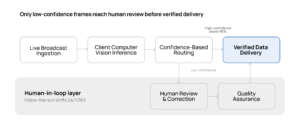
Figure 1: Verified Data Delivery Workflow – 6 Stages & 1 Routing Branch
High-confidence predictions go straight to verified delivery; low-confidence ones pass through human review and quality assurance first.
Precision Logo Annotation for More Reliable Sponsorship Valuation
One of the most important improvements involved replacing approximate logo boundaries with more precise geometric annotations.
Since sponsorship media valuation depends on the visible screen area occupied by a brand logo, even small annotation inaccuracies can influence exposure calculations. LabelOps introduced oriented bounding boxes and polygon segmentation to improve the representation of sponsor logos across challenging broadcast environments.
Oriented Bounding Box Annotation for Sports Broadcasts
Standard Axis-Aligned Bounding Boxes are not always suitable for sponsor logos appearing at different angles or on moving surfaces.
LabelOps implemented oriented bounding box annotation for sports to represent logos according to their actual orientation. Unlike conventional rectangular boxes, OBB annotations can rotate to align with the visible dimensions of a logo.
This is particularly useful when annotating:
• Sponsor logos displayed on angled LED advertising boards.
• Branding appearing on curved or moving player jerseys.
• Logos captured during camera pans and changing broadcast angles.
• Rotated sponsor placements and distorted visual surfaces.
By aligning annotation boundaries more closely with the actual logo geometry, OBB annotation reduces unnecessary background inclusion and improves the consistency of visible-area measurements.
Polygon Segmentation for Irregular Logo Boundaries
Some sponsor logos cannot be accurately represented using rectangular bounding boxes alone. Irregular logo shapes, curved jersey placements, and partially visible branding require more detailed boundary representation.
LabelOps used polygon segmentation to capture the actual contours of visible sponsor logos. These polygon masks helped exclude irrelevant background pixels and supported more precise calculations of visible sponsor surface area. Combining OBB annotation with polygon segmentation enabled the platform to handle different logo geometries more consistently across sports broadcast footage.
Measuring Visible Logo Surface Area
For sponsorship valuation, identifying a logo is only the first step. The platform must also determine how much of that logo is genuinely visible within a broadcast frame.
LabelOps focused on precise geometric annotation to help distinguish actual sponsor exposure from empty background regions. By improving the boundaries around visible logos, the workflow supported more reliable screen-share calculations and reduced the risk of inflated media valuation metrics.
The annotation framework enforced a minimum 95% Intersection over Union (IoU) threshold for geometric validation, supporting consistent boundary accuracy across the workflow. This helped transform approximate logo detections into more defensible sponsorship exposure measurements.
Sponsorship Exposure Validation Through Contextual Annotation and Quality Assurance
Accurate sponsorship valuation requires more than geometric precision. It also requires understanding the visual conditions surrounding each logo detection. LabelOps introduced contextual annotation and multi-stage quality assurance to improve the reliability of exposure classification across challenging sports broadcast frames.
Classifying Logo Occlusion, Motion Blur, and Visual Clarity
The annotation workflow incorporated a multi-class taxonomy to evaluate the visibility and quality of detected sponsor logos. Instead of treating every detected logo as an equally valid exposure, annotators assessed the visual conditions affecting each appearance.
The classification process included:
• Occlusion Percentages: Identifying how much of a sponsor logo was obscured, including predefined ranges such as 25–50% blocked.
• Motion Blur Intensity: Classifying blur conditions that could affect logo visibility and recognition.
• Focal Contrast: Evaluating the contrast between the logo and its surrounding visual environment.
• Partial Visibility: Distinguishing valid partial exposures from detections with insufficient visual evidence.
• Lighting-Related Distortion: Reviewing difficult frames affected by stadium floodlights and glare.
These contextual attributes helped the platform distinguish clearly visible sponsorship appearances from uncertain or partially obscured detections. This process strengthened Sponsorship exposure validation by combining geometric accuracy with contextual visual assessment.
Multi-Stage Annotation Review and Statistical Auditing
To maintain reliable annotation quality at scale, LabelOps implemented a multi-stage verification framework. The quality assurance process followed three stages:
• Annotator Review: Initial annotations were completed by trained, sport-aware specialists who corrected logo boundaries and assigned contextual visibility labels.
• Lead QA: Annotation outputs underwent additional review by quality leads to identify inconsistencies and incorrect classifications.
• Statistical Audit Sampling: Selected annotations were independently audited to evaluate consistency, identify recurring errors, and maintain quality standards.
This dual-pass verification approach helped prevent inaccurate annotations from entering the final delivery pipeline. The workflow also maintained an Inter-Annotator Agreement (IAA) Cohen’s Kappa score of at least 0.85, supporting consistent annotation decisions across teams and projects.
Maintaining Consistency Through Inter-Annotator Agreement
Sports broadcast annotation involves subjective visual conditions, particularly when evaluating partially obscured logos, motion blur, and difficult lighting. Without clearly defined annotation guidelines, different annotators may interpret the same visual exposure differently.
LabelOps addressed this challenge through structured annotation taxonomies and agreement checks. Cohen’s Kappa-based evaluation helped measure the consistency of annotation decisions beyond simple percentage agreement. Maintaining an IAA score of at least 0.85 helped establish a consistent interpretation of logo visibility, occlusion, and exposure quality across the annotation workforce.
The Active Learning Workflow: Turning Corrected Annotations into Model Improvements
Improving annotation quality should also contribute to the continuous development of the underlying computer vision models.
LabelOps incorporated an active learning feedback workflow in which corrected edge cases were converted into structured ground-truth annotations and returned to the client’s machine learning pipeline.
This ensured that human verification contributed to future model improvements rather than functioning only as a final quality checkpoint.
The workflow focused on four areas:
1. Structured COCO JSON Delivery
Corrected annotations were packaged in COCO JSON format to support integration with the client’s existing machine learning workflows.
The structured outputs included verified geometric annotations and relevant contextual labels.
2. Recurring Error Identification
Human corrections helped identify recurring model weaknesses, including inaccurate logo boundaries, difficult jersey placements, partial occlusions, and visually distorted sponsor appearances.
3. Feedback for Reducing Model Blind Spots
Verified edge cases provided high-quality ground-truth examples that could be used to address recurring computer vision detection and classification errors.
4. More Frequent Model Iteration
The client’s annotation feedback cycle moved from monthly retraining to weekly annotation feedback and retraining ingestion.
This allowed the platform to incorporate new jersey designs, sponsor placements, and previously challenging visual conditions into more frequent model improvement cycles.
Through this approach, sports broadcast annotation became an important part of the client’s ongoing computer vision development strategy.
Results: Faster Turnaround and 99.2% Verified Precision
The implementation of LabelOps’ sport-aware annotation workflow delivered measurable improvements in operational efficiency, annotation precision, and weekend processing coverage.
By combining confidence-based routing, precision geometric annotation, continuous operational coverage, and multi-stage quality assurance, the platform significantly improved its ability to deliver verified sponsorship data.
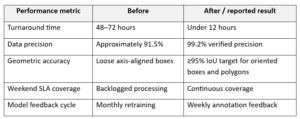
The table below compares the client’s workflow before LabelOps with the reported results afterward.
Faster Sponsorship Reporting
The reduction of the turnaround time from 48–72 hours to under 12 hours significantly improved the platform’s ability to process weekend broadcast footage. Frankly, this 65% reduction helped eliminate the Monday morning processing backlog and enabled the platform to deliver verified sponsorship data closer to the original broadcast schedule. Also, this improvement supported more predictable reporting timelines and helped the platform maintain its commitments to brands and rights holders.
More Reliable Logo Measurements
The introduction of OBB and polygon annotations improved the representation of sponsor logos across different broadcast conditions. With a minimum 95% IoU validation threshold, the annotation workflow provided a more precise geometric framework for measuring visible logo areas.
This addressed the problem of loose bounding boxes artificially inflating screen-share calculations and helped the platform produce more defensible sponsorship media valuation metrics. The client also reported zero brand audit clawbacks over a 12-month period following the implementation.
Continuous Feedback for Computer Vision Models
The active learning workflow allowed corrected annotations to become reusable ground-truth data for the client’s computer vision pipeline. By moving from monthly retraining to weekly annotation feedback and retraining ingestion, the platform established a more frequent model improvement cycle.
This helped the computer vision team incorporate new sponsor placements, jersey designs, and challenging broadcast conditions into its ongoing model development process. The result was not simply a faster annotation operation, but a more responsive data quality framework supporting continuous AI improvement.
Why LabelOps Supports High-Volume Sports Intelligence Workflows
Sports intelligence platforms require an annotation partner that understands the operational and technical demands of sponsorship valuation. Generic annotation workflows may identify objects, but sponsorship valuation requires precise logo boundaries, contextual exposure classification, and reliable processing across high-volume broadcast environments.
LabelOps supports these requirements through five key capabilities.
1. Sport-Aware Annotation Specialists
Our specialists understand the visual complexities of sports broadcasts, including warped jersey logos, angled LED advertising boards, broadcast overlays, and partially obscured sponsor placements.
2. Reliable Sponsorship Exposure Measurements
OBB annotation, polygon segmentation, and contextual visibility labels help improve the reliability of sponsor exposure measurements and downstream media valuation.
3. Scalable Operations for Major Sporting Events
Our 24/7/365 Follow-the-Sun operational model provides continuous annotation coverage across APAC, EMEA, and Americas shifts, helping manage high-volume weekend workloads.
4. Reduced Operational Overhead for Engineering Teams
LabelOps manages annotation execution, specialist review, and quality assurance, allowing client engineering teams to focus on computer vision development instead of coordinating annotation backlogs.
5. Quality-Controlled Annotation and Structured Data Delivery
Multi-stage QA, IoU validation, inter-annotator agreement checks, and structured data delivery help maintain consistency across large-scale sports annotation projects.
With LabelOps, sports intelligence platforms can strengthen their data preparation workflows without compromising annotation quality or operational responsiveness.
Sports Broadcast Annotation Capabilities and Data Delivery
LabelOps supports a range of annotation techniques and quality assurance processes designed for sports sponsorship intelligence, computer vision development, and broadcast data analysis.
Supported Annotation Types
Our sports broadcast annotation capabilities include:
• Oriented Bounding Boxes (OBB): For accurately representing rotated and skewed sponsor logos.
• Polygon Segmentation: For capturing irregular logo boundaries and visible surface areas.
• Keypoint Tracking: For identifying and tracking relevant visual reference points.
• Frame-by-Frame Video Tracking: For maintaining object and logo tracking across sequential broadcast frames.
• Occlusion and Visual Clarity Labels: For classifying partial visibility, motion blur, and other visual conditions affecting exposure quality.
Quality Assurance and Data Formats
Maintaining consistency across large-scale sports annotation projects requires measurable quality controls and structured delivery formats.
LabelOps incorporates:
• Annotator-level review and lead QA.
• Statistical audit sampling.
• Intersection over Union (IoU) measurement.
• Inter-Annotator Agreement (IAA) evaluation.
• Structured COCO JSON delivery.
• YOLO-compatible annotation formats.
• Custom API schema integration.
These capabilities help sports intelligence teams integrate verified annotations into their existing computer vision, sponsorship analytics, and machine learning pipelines.
Data Security for Unreleased Sports Footage
Sports broadcast footage, particularly unreleased content and proprietary sponsor data, requires controlled handling throughout the annotation lifecycle.
LabelOps’ documented security framework includes:
• Strict NDA compliance.
• SOC 2-aligned security practices.
• Air-gapped QA environments for unreleased broadcast footage.
These measures support controlled annotation operations and help protect sensitive client footage and proprietary data throughout the processing workflow.
Validate Your Current Workflow with a Blind Data Quality Bake-Off
Is your existing annotation provider accurately measuring sponsor exposure, or are loose bounding boxes and incorrect visibility classifications affecting your media valuation reports?
The difference between approximate logo detection and valuation-grade annotation can have a direct impact on the reliability of sponsorship intelligence.
LabelOps invites sports intelligence platforms, sponsorship analytics providers, and computer vision teams to evaluate their existing annotation workflows through a Blind Data Quality Bake-Off.
Submit 500 challenging, edge-case-heavy sports broadcast frames for a side-by-side technical evaluation of your current annotation output against LabelOps’ sport-aware Human-in-the-Loop workflow.
What We Evaluate
• Logo Boundary Precision: How accurately do annotations represent actual sponsor logo boundaries?
• IoU and Geometric Accuracy: How closely do annotated regions align with the visible logo surface?
• Occlusion Tagging: Are partially obscured logos classified consistently?
• Annotation Consistency: Do different annotators produce reliable and repeatable results?
• Data Suitability for Sponsorship Valuation: Can the resulting annotations support reliable exposure measurements and downstream valuation workflows?
Why Participate?
• Zero cost.
• Zero risk.
• A side-by-side technical evaluation of annotation quality.
• Actionable insights into your existing data preparation workflow.
CTA: Request a Blind Data Quality Bake-Off
Let your broadcast data demonstrate the difference that precision annotation can make.
Frequently Asked Questions About Sports Sponsorship Valuation Data Annotation
1) How Does Human-in-the-Loop Sports Data Annotation Improve Valuation Accuracy?
Human-in-the-loop sports data annotation improves valuation accuracy by introducing specialist verification into automated computer vision workflows. Human annotators review low-confidence detections, correct inaccurate logo boundaries, classify occlusion, and evaluate visual clarity. This helps reduce false-positive detections, prevent incorrect exposure measurements, and produce more reliable ground-truth data for sponsorship valuation.
2) Why Is Logo Detection Annotation Important for Sports Broadcasts?
Logo detection annotation helps identify and measure sponsor visibility across live and recorded sports broadcasts. Accurate logo boundaries are important because sponsorship valuation often depends on the visible screen area occupied by a brand. Incorrect bounding boxes can include background pixels, artificially increasing screen-share calculations and potentially inflating media value. Precision annotation helps produce more reliable exposure measurements.
3) What Is Oriented Bounding Box Annotation for Sports?
Oriented Bounding Box (OBB) annotation is a geometric annotation technique that represents objects using rotated rectangular boundaries rather than conventional horizontal and vertical bounding boxes. In sports broadcasts, OBB annotation is particularly useful for sponsor logos appearing on angled LED boards, moving jerseys, and rotated surfaces. It helps align annotation boundaries more closely with the actual orientation of the logo.
4) How Does Sponsorship Exposure Validation Handle Occluded Logos?
Sponsorship exposure validation uses contextual annotation to evaluate how much of a logo is visible and whether the detected exposure can be reliably classified. Annotators assign occlusion percentages, assess motion blur, and evaluate focal contrast. These labels help distinguish clearly visible sponsor appearances from partially obscured or uncertain detections, supporting more consistent valuation decisions.
5) How Can Sports Broadcast Annotation Teams Handle Weekend Match Volumes?
Sports broadcast annotation teams can handle weekend match volumes through scalable staffing, confidence-based routing, and continuous operational coverage. A Follow-the-Sun model distributes annotation workloads across APAC, EMEA, and Americas shifts. Combined with automated high-confidence processing and specialist human review of low-confidence detections, this approach helps prevent weekend backlogs and maintain demanding reporting SLAs.