Top 10 Data Annotation & Labeling Companies for Enterprise AI in 2026

An enterprise buyer’s guide to managed annotation workforces, AI data platforms, quality assurance, security, scalability, and production Computer Vision workflows.


Building production computer vision or enterprise AI requires more than a capable model architecture. The quality, consistency, and security of your training data directly determine how reliably that model performs outside the lab.

For enterprise AI teams, choosing a data annotation company is not simply about labeling the most images at the lowest cost. The decision affects model development timelines, engineering workload, data security posture, quality assurance overhead, and whether your pipeline can scale to production volumes.

Different providers operate in fundamentally different ways. Some provide annotation platforms for internal teams. Others provide managed annotation workforces. A smaller number combine data annotation with model development, system integration, and deployment.

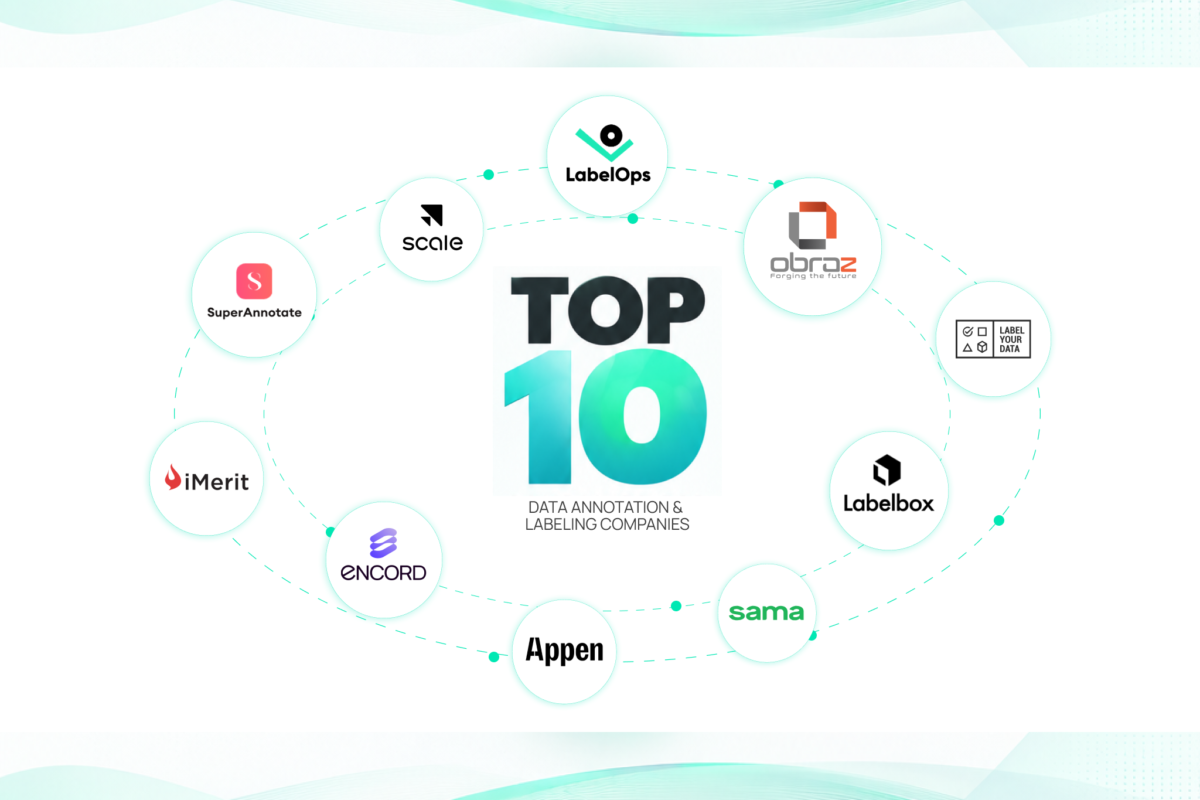
This guide compares 10 leading data annotation and labeling companies relevant to enterprise AI in 2026, evaluated across annotation quality, workforce model, security and data handling, modality coverage, scalability, and workflow integration.

At a Glance: Which Provider Fits Your AI Data Workflow?

      • Need a managed annotation workforce? LabelOps
      • Need annotation plus CV engineering and deployment? Obraz
      • Need large-scale AI data operations? Scale AI
      • Need specialized 3D/LiDAR annotation? Label Your Data
      • Need a multimodal annotation platform? SuperAnnotate
      • Need domain-focused managed teams? iMerit
      • Need an AI data infrastructure platform? Labelbox
      • Need complex medical/video data workflows? Encord
      • Need managed high-consistency annotation? Sama
      • Need global multilingual data programs? Appen

Comparison at a Glance

CompanyBest Suited ForOperating ModelKey Strengths
LabelOpsManaged, high-volume annotationManaged workforceScalable delivery, QA, image/video/audio/NLP
ObrazSecure CV engineering + annotationIn-houseData sovereignty, SegForge, full-lifecycle CV
Scale AILarge-scale AI data programsPlatform + managed dataData Engine, evaluation, 3D, GenAI
Label Your DataSpecialized 3D/LiDAR annotationManaged services3D point clouds, tool-agnostic, security
SuperAnnotateMultimodal annotation workflowsPlatform + servicesPixel-perfect tooling, LLM fine-tuning, multimodal
iMeritDomain-focused annotationManaged teamsHealthcare, geospatial, compliance
LabelboxAI data infrastructurePlatformWorkflow editors, evaluation, RL environments
EncordMedical, video, 3D/LiDAR dataPlatformDICOM/NIfTI, video tracking, sensor fusion
SamaManaged workforce annotationManaged workforceConsistent IAA, 3D, automotive/robotics
AppenGlobal multilingual AI dataDistributed workforce80+ languages, speech, global scale

What Should Enterprises Evaluate in a Data Annotation Company?
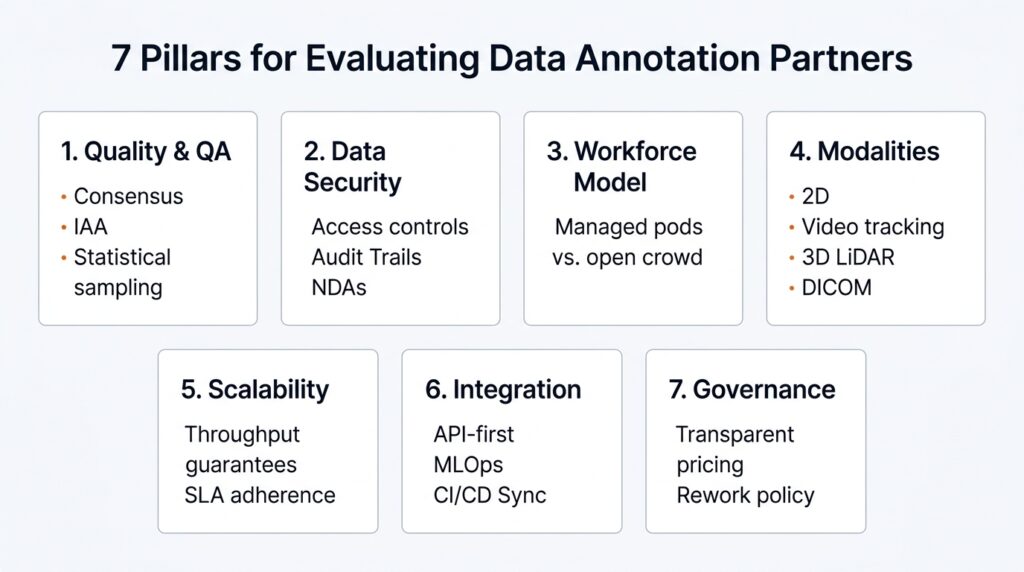
Infographic illustrating the 7 critical pillars enterprise AI teams evaluate when selecting a data annotation partner.
The 7 architectural pillars for evaluating enterprise data annotation partners, from QA consensus and security to MLOps integration.

Before comparing individual vendors, establish your baseline requirements.

Annotation Quality and QA

Look beyond headline accuracy numbers. Evaluate how the provider handles inter-annotator agreement, ambiguous classes, edge cases, occlusion, multi-stage review, automated quality checks, and rework processes. For production computer vision, the quality of a small set of difficult examples often matters more than volume.

Security and Data Handling

Enterprise datasets can contain proprietary products, manufacturing environments, medical images, or defense-related information. Evaluate access controls, workforce model, workstation and network controls, data transfer and storage, retention and deletion policies, third-party dependencies, and applicable certifications.

Workforce Model and Domain Expertise

The gig-economy crowdsourcing model can create challenges for enterprise AI. Complex tasks such as sensor fusion or DICOM annotation may require specialized training, domain expertise, and consistent quality controls rather than a broadly distributed workforce. Common models include open crowdsourcing, managed teams, dedicated project pods, and specialist annotators.

Annotation Modalities
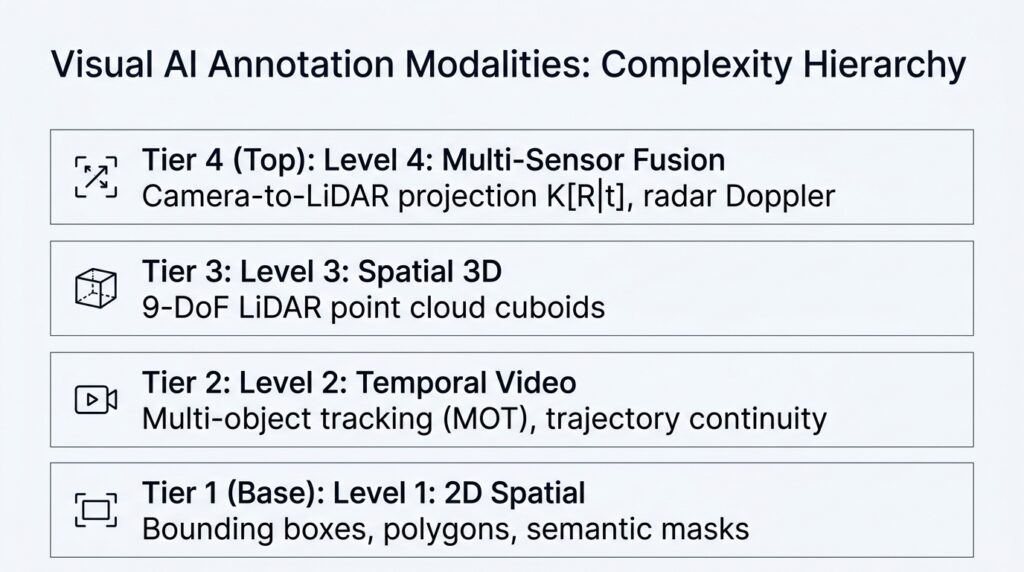
Technical diagram comparing visual AI annotation complexity levels from 2D spatial masks to multi-sensor fusion calibration.
The visual AI annotation complexity hierarchy, spanning foundational 2D spatial masks to multi-sensor LiDAR and radar fusion.

Your partner must support the data topologies your models consume: computer vision data annotation for 2D/3D bounding boxes and polygon segmentation, temporal video annotation for multi-object tracking, 3D point clouds and LiDAR cuboids, NLP and audio, and medical formats like DICOM and NIfTI. Output schemas (COCO, Pascal VOC, KITTI, ROSBAG) and integration requirements should be evaluated before a project begins.

Scalability and Throughput

A vendor that performs well on a pilot may not perform the same way at production scale. Evaluate workforce scaling, quality at higher volumes, SLA management, rework processes, dataset versioning, and handling of changing ontologies.

Platform and Workflow Integration

The annotation environment should integrate into your ML lifecycle. Look for API-first architectures, model-assisted labeling, active learning loops, cloud storage integration, and seamless connection between annotation and training production AI models.

Pricing and Engagement Models

Move beyond per-image pricing. Evaluate FTE dedicated pods, tiered-volume structures, and outcome-based pricing that includes QA and rework. Understand how edge-case handling, ontology updates, and rush requirements affect the final cost.

Top 10 Data Annotation & Labeling Companies in 2026

1. LabelOps

Best for: Managed, high-volume data annotation and dedicated annotation workforces.

LabelOps is built for enterprises that have strong internal ML engineering teams but need a scalable, managed annotation workforce to fuel their data pipelines. It operates on dedicated hourly and tiered-volume structures (scaling to 55,000+ hours), providing guaranteed throughput for large spatial datasets and high-velocity video streams. LabelOps currently reports more than 2,000 annotators, more than 2 billion labels delivered, and 99.87% accuracy.

Managed Workforce: A managed, employee-level workforce with strict performance metrics, ensuring high IAA scores and consistent taxonomy application across projects.

Capabilities: Comprehensive support across image, video, audio, and NLP, with deep expertise in complex video annotation services and multi-frame tracking.

Quality Assurance: Built-in, multi-tier QA layers and direct communication channels between your ML engineers and annotation pod leads.
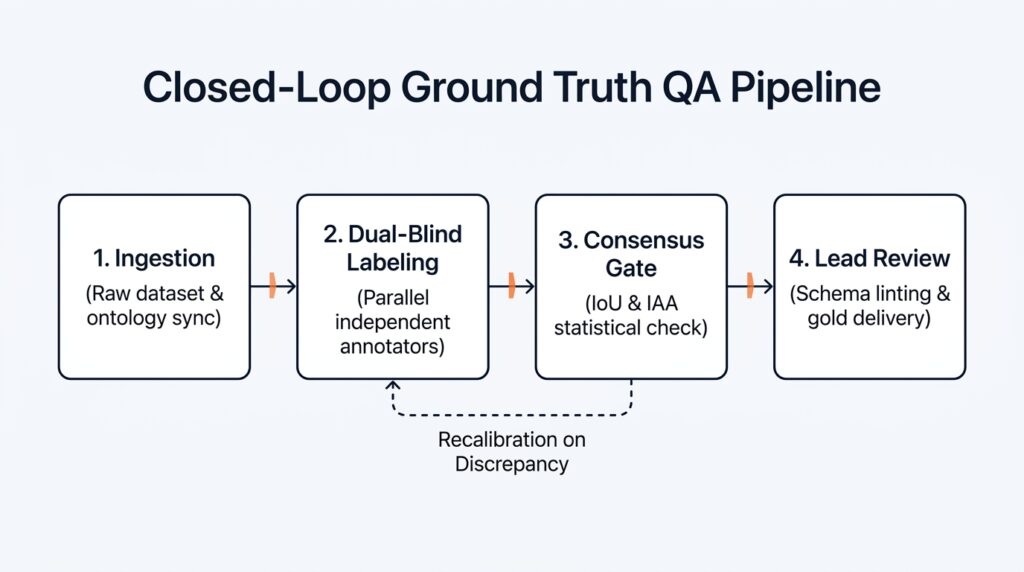
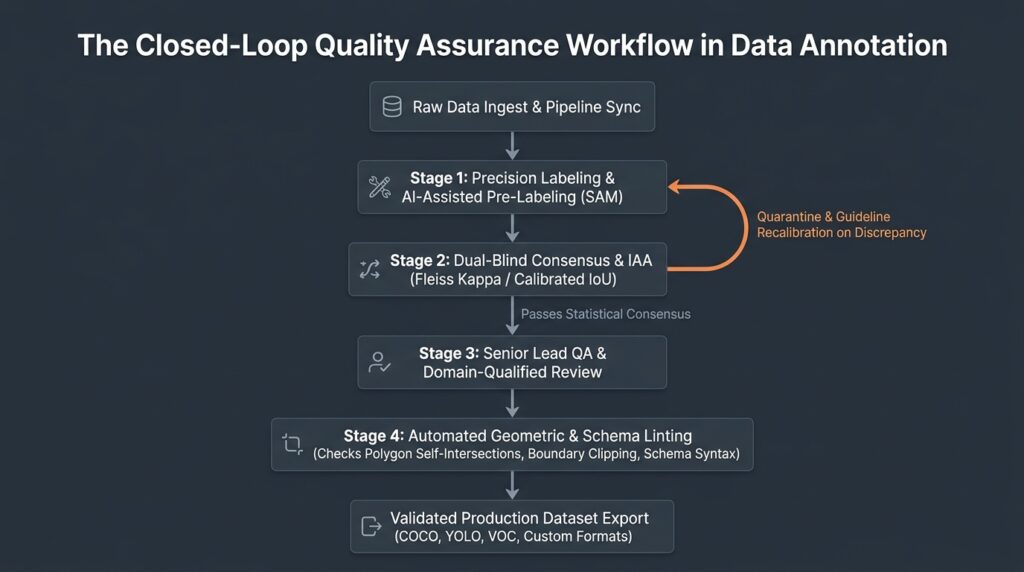
Flowchart diagram illustrating the closed-loop quality assurance workflow in data annotation including dual-blind consensus and lead QA review.
The closed-loop quality assurance workflow powering enterprise ground truth delivery.

Enterprise Use Cases: High-volume retail analytics, large-scale spatial computing datasets, and continuous active-learning loops for production CV models.

Why It May Fit: A strong fit for enterprises that need a dedicated, scalable external workforce integrating into their existing MLOps infrastructure without sacrificing quality.

What to consider: Designed for enterprises that need a managed external workforce. Organizations requiring full end-to-end CV engineering and deployment should also evaluate Obraz.

2. Obraz

Best for: Secure, in-house annotation and integrated Computer Vision engineering.

Obraz approaches computer vision as full-stack software engineering. While most AI data annotation companies treat labeling as an isolated task, Obraz connects annotation to the entire Computer Vision lifecycle: use-case definition, data annotation, dataset engineering, model development, validation, optimization, and deployment.

Obraz uses SegForge, its proprietary annotation platform, as part of its controlled in-house data annotation infrastructure. SegForge is engineered for zero-trust security, air-gapped workflows, and cryptographic audit logs.

Engineering-Grade Ground Truth: Annotation teams work directly alongside CV engineers and domain experts. The data is annotated with a precise understanding of the model’s architectural requirements and edge-case vulnerabilities.

End-to-End Integration: From secure data ingestion to custom SaaS integration and edge deployment, Obraz handles the entire lifecycle.

Enterprise Use Cases: Highly sensitive defense imagery, proprietary manufacturing defect detection, and secure medical AI pipelines.

Why It May Fit: If your project involves highly classified or proprietary data and you need a partner to engineer the entire pipeline (from secure ground truth to a deployed system), Obraz eliminates vendor fragmentation and security risks.

What to consider: Obraz’s integrated engineering model is designed for projects that require more than annotation alone. Teams that only need a managed annotation workforce should evaluate LabelOps directly.

3. Scale AI

Best for: Large-scale AI data and enterprise AI programs.

Scale AI is one of the largest players in the AI data space, known for solving the data bottleneck for foundational models and autonomous systems. Their Data Engine combines automation with human expertise to curate training data for massive enterprise AI programs.

Capabilities: Large-scale data processing, RLHF for LLMs, 3D sensor fusion, and complex autonomous vehicle data annotation.

Enterprise AI: Enterprise-grade SLAs, dedicated customer operations, and advanced model evaluation tooling.

Why It May Fit: Relevant for well-funded enterprises and AV companies needing to process petabytes of raw sensor data and build foundational models.

What to consider: Designed for large-scale enterprise programs. Teams with smaller or highly specialized CV projects may find the commercial model better suited to high-volume engagements.

4. Label Your Data

Best for: Enterprise data labeling and specialized annotation workflows.

Label Your Data operates as a highly secure, tool-agnostic data-labeling partner. They provide human-powered annotation services for organizations that need to create complex datasets without being locked into a specific software ecosystem.

Capabilities: Strong focus on LiDAR, 3D cuboids, skeletal keypoint annotation, and 3D point cloud annotation.

Security: Enterprise-grade security protocols and a managed workforce model that avoids public crowdsourcing.

Why It May Fit: A strong fit for robotics and spatial computing teams that require specialized 3D annotation but prefer to manage their own ML models internally.

What to consider: Operates as a data labeling service partner rather than providing full software system integration or CV engineering.

5. SuperAnnotate

Best for: Multimodal AI data infrastructure and annotation workflows.

SuperAnnotate has evolved into a comprehensive multimodal data orchestration platform. They support image, video, text, and audio, with a strong emphasis on agentic AI and human-in-the-loop workflows.

Capabilities: Advanced UI tooling for pixel-perfect segmentation, LLM fine-tuning data, and multimodal dataset management.

Why It May Fit: Well suited for enterprises building multimodal foundation models or agentic AI systems that require complex data orchestration and have the internal workforce to execute the labeling.

What to consider: Primarily a software platform. While managed labeling marketplace options exist, the core strength is the annotation tooling itself.

6. iMerit

Best for: Specialized enterprise annotation and domain-focused AI data.

iMerit provides managed data annotation services through specialized, full-time teams. They focus heavily on building domain-specific pods for industries like healthcare, agriculture, and autonomous systems.

Capabilities: Strong compliance frameworks (HITRUST, ISO 27001, SOC 2), geospatial data annotation, and medical image annotation support.

Why It May Fit: Suitable for enterprises that require dedicated, domain-focused teams for ongoing production workflows, particularly in regulated industries.

What to consider: Better suited for large ongoing operational programs rather than rapid prototyping or short-term engagements.

7. Labelbox

Best for: AI data infrastructure and internal AI teams.

Labelbox has transitioned from a pure training data platform into a comprehensive AI data infrastructure provider. Their current focus includes AI agent evaluation, reinforcement learning (RL) environments, and human preference data.

Capabilities: Node-based workflow editors, LLM-as-a-judge evaluations, and programmatic quality assurance.

Why It May Fit: Ideal for internal AI teams building agentic workflows or RL environments who need a platform to manage their own data pipelines and evaluation metrics.

What to consider: As a platform, you must still manage the integration of your own workforce or BPO partners for the actual annotation operation.

8. Encord

Best for: Multimodal, medical, video, and 3D/LiDAR data workflows.

Encord is a highly specialized platform utilizing advanced micro-models and multi-stage QA for complex visual data. They excel in temporal tracking and multi-sensor environments.

Capabilities: Native support for DICOM/NIfTI medical image annotation, complex video tracking, and sensor fusion workflows.

Why It May Fit: Particularly relevant for healthcare AI and autonomous systems teams dealing with heavy video and 3D/LiDAR datasets who need advanced data curation and active learning tooling.

What to consider: Focused on tooling and data evaluation. Custom quote-based pricing requires direct engagement to scope.

9. Sama

Best for: Managed annotation with a full-time workforce.

Sama’s primary differentiator is its dedicated, full-time workforce, which produces highly consistent IAA scores. They are heavily utilized for high-volume image, video, and 3D workflows.

Capabilities: 3D point-cloud annotation, sensor fusion, and multi-frame object labeling.

Why It May Fit: A strong fit for enterprises looking to outsource annotation to a managed workforce rather than relying on crowdsourcing, particularly for automotive and robotics applications.

What to consider: The full-time employee model may carry higher per-unit costs compared to crowdsourced alternatives.

10. Appen

Best for: Global-scale and multilingual AI data programs.

Appen is one of the oldest players in the AI data space, utilizing a large global workforce to handle text, speech, and image annotation services across 80+ languages.

Capabilities: Multilingual NLP, global data collection, and red-teaming for LLMs.

Why It May Fit: Relevant for global enterprises needing geographically diverse data collection and multilingual localization.

What to consider: The distributed crowdsourcing workforce model can introduce quality variance for highly complex or proprietary computer vision tasks that require strict domain expertise.

How to Choose: Platform vs. Managed Workforce vs. Engineering Partner

When evaluating data annotation companies, the first decision should not be “which company is number one.” It should be: what operating model does your AI program require?
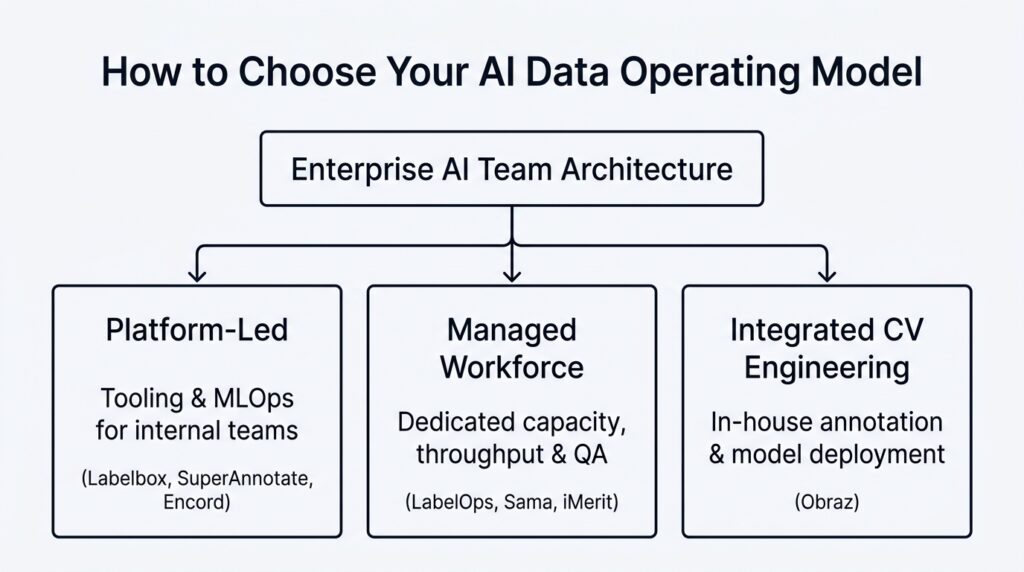
Decision tree diagram illustrating how enterprise AI teams choose between platform-led, managed workforce, and integrated CV engineering models.
Operating model decision framework for enterprise AI data architectures.

Choose a platform if your internal team has the people and processes to manage annotation but needs software for dataset management, quality control, workflow automation, and model-assisted labeling. Labelbox, SuperAnnotate, and Encord serve this model.

Choose a managed annotation workforce if your ML team has engineering capability but does not want to build and manage a large annotation operation internally. LabelOps, Sama, and iMerit serve this model.

Choose an integrated engineering partner if annotation is only one component of the system you are building and the project requires data annotation, dataset engineering, model development, validation, software integration, and deployment to work together. Obraz serves this model.

If you need high-volume, linguistically diverse data collection across global markets, Appen and similar distributed-workforce providers cover that segment.

Planning an Enterprise Data Annotation Project?

The right annotation partner depends on your dataset, annotation requirements, quality targets, security constraints, expected volume, and ML workflow.

LabelOps can help scope the annotation workforce, workflow, quality process, and delivery model required for your project. Whether you are building ADAS training data pipelines, 3D point cloud datasets for robotics, or secure DICOM annotation for healthcare AI, start with the operational requirements of your model.

Share your dataset type, annotation requirements, expected volume, and QA targets with the LabelOps team.

Explore LabelOps Data Annotation Services

Discuss Your Annotation Requirements

Frequently Asked Questions

What is a data annotation company?

A data annotation company provides the people, processes, and/or software required to label datasets used to train and evaluate machine learning and AI systems. Depending on the provider, services can include image, video, text, audio, LiDAR, 3D point-cloud, and other specialized annotation workflows. Enterprise-grade providers typically add managed workforces, multi-tier quality assurance, data security protocols, and integration with production ML pipelines.

What is the difference between a managed annotation workforce and crowdsourced annotation?

Managed annotation workforces employ dedicated, full-time annotators who are trained on your specific ontology and maintain consistent IAA scores across large datasets. Crowdsourced annotation distributes tasks across a broad pool of on-demand workers. Managed teams are generally better suited for enterprise projects where data security, domain expertise, and annotation consistency are critical requirements. The appropriate model depends on the dataset, risk profile, complexity, and operational requirements.

How do I choose the right data annotation partner for enterprise AI?

Evaluate partners across seven dimensions: annotation quality and QA processes, security and data handling, workforce model (managed vs. crowdsourced), supported annotation modalities, scalability and throughput guarantees, platform and workflow integration capabilities, and pricing transparency. The right choice depends on whether you need a dedicated external workforce, a self-serve platform, or a full-stack engineering partner that handles annotation through deployment.

What data modalities should an enterprise annotation partner support?

Production AI projects typically require support for 2D image annotation (bounding boxes, polygons, semantic segmentation), video annotation with temporal tracking, 3D point cloud and LiDAR cuboid annotation, text and NLP labeling, audio transcription and alignment, and medical-specific formats like DICOM and NIfTI. Your partner’s tooling must natively support the output schemas your training pipeline consumes (COCO, Pascal VOC, KITTI, ROSBAG, and others).

Why is data security important when choosing an annotation company?

Enterprise AI projects often involve proprietary manufacturing data, classified defense imagery, or patient health information. Sending this data to broadly distributed annotation platforms introduces data sovereignty risks, compliance exposure, and potential IP leakage. Secure annotation partners enforce controlled workstation access, workforce screening, network restrictions, documented data-handling policies, and compliance with applicable frameworks such as HIPAA, GDPR, ISO 27001, and SOC 2.

What is the difference between LabelOps and Obraz?

LabelOps focuses on managed data annotation operations and annotation workforces. Obraz combines controlled in-house annotation (through LabelOps) with Computer Vision engineering, dataset development, model development, software integration, and deployment. The two serve different enterprise operating models: LabelOps for teams that need a scalable annotation workforce alongside their own engineering, Obraz for teams that need the data and engineering layers to work together end to end.

Synthetic Data Validation: How to Bridge the Sim2Real Gap with Real-World Ground Truth


Generating synthetic data at scale is no longer the hardest part of the problem. The harder question is whether that data represents the conditions a computer vision model will encounter in reality. This article examines how real-world ground truth, statistical diagnostics, sensor-level validation, HITL QA, and TSTR benchmarking can turn synthetic data generation into a measurable Sim2Real engineering process.


Key Takeaways

    • Synthetic data generation solves a volume problem, but synthetic data validation solves a performance problem.
    • The Sim2Real domain gap persists because of simulation artifacts, sensor mismatches, and scenario coverage deficiencies.
    • Statistical distribution metrics like FID are useful diagnostics but cannot replace task-level evaluation on real-world inputs.
    • Real-world ground truth provides the empirical anchor for measuring synthetic dataset utility in the target domain.
    • Human-in-the-loop (HITL) quality assurance catches semantic errors and physical implausibilities that automated metrics miss.
    • Validation must function as an iterative feedback loop to inform and refine the synthetic generation pipeline.

Synthetic data can produce millions of labeled examples without the acquisition cost of physical data collection. But internal consistency does not guarantee that a synthetic dataset represents the sensors, environments, failure modes, and scenario frequencies of the production domain.


The validation problem is therefore different from the generation problem: can a model trained on synthetic data improve or preserve performance on representative real-world data?


Answering that question requires more than visual inspection. A rigorous validation framework combines distributional diagnostics, sensor-level analysis, real-world ground truth, human-in-the-loop quality assurance, and downstream task evaluation such as Train on Synthetic, Test on Real (TSTR).

This article examines how these layers work together to measure synthetic-data utility and feed evidence back into the generation pipeline.


Synthetic Data Solves a Generation Problem, Not a Validation Problem

Generating synthetic data and validating synthetic data are distinct engineering problems.


A generation pipeline answers: Can we create the data?


A validation pipeline answers: Does that data behave like useful evidence for the real-world task?

Modern PBR, rendering, and neural-rendering pipelines can produce enormous datasets with internally consistent labels. But rendering capability does not automatically establish that the resulting data represents the statistical, sensor, and environmental characteristics of the target operational domain.


Volume of synthetic data does not establish its representativeness. Machine learning models are exceptionally efficient at identifying and exploiting spurious correlations within their training data. If a synthetic pipeline generates one million images of vehicles, but all vehicles possess perfectly uniform surface reflectance properties, the network will learn to rely on that uniformity. When deployed in the real world, where surface reflectance is modulated by dirt, variable weather conditions, and inconsistent lighting, the model will likely fail.


Validation is the empirical process of proving that the features learned from synthetic environments map correctly to the feature space of the real world. It requires moving beyond visual inspection and implementing systematic, quantitative checks. Separating generation from validation ensures that the synthetic pipeline is continuously held accountable to real-world performance metrics.


Why Synthetic Data Fails to Transfer Perfectly to Reality

Synthetic data does not automatically reproduce the statistical and physical conditions encountered by a deployed computer vision system. The Sim2Real domain gap is the difference between the simulated training environment and the real-world environment in which the model must operate.


The gap can arise at several levels:

    • Appearance: Textures, colors, illumination, reflections, and rendering artifacts.
    • Sensor behavior: Noise, optical distortion, exposure limits, temporal effects, and ISP processing.
    • Content and coverage: Object configurations, scenario frequency, environmental conditions, and rare events.

The following sections examine how these differences become measurable validation problems.

The Sim2Real Domain Gap

Models trained on idealized synthetic renders can overfit to simulation artifacts, including overly clean geometry, uniform lighting distribution, and the absence of complex, non-linear sensor noise.

Neural networks learn statistical representations from their training distribution rather than possessing an inherent guarantee of physical-world invariance. The gap between synthetic and real distributions means that the network will map its learned representations to the synthetic manifold. If the real-world manifold diverges significantly, the network will produce low-confidence or incorrect predictions.

Simulation Artifacts and Sensor Mismatch

Real-world physical sensors introduce complex alterations to the light they capture. When synthetic pipelines fail to accurately model these specific hardware characteristics, they introduce critical discrepancies.


Validation turns these physical differences into measurable diagnostic signals:


Real-World FactorSynthetic Data RiskWhat Validation Reveals
Photon noise and read noiseUnrealistically clean low-light imagesSensor statistics mismatch
Lens distortionIncorrect geometry at image edgesCalibration comparison failures
ISP processingColor and texture mismatchImage pipeline discrepancies
Rolling shutterIncorrect temporal geometrySequence-level evaluation gaps
Motion blurUnrealistic object appearanceReal sequence comparison failures


This table illustrates the diagnostic value of validation. Validation does not dictate how to simulate a complex Image Signal Processor (ISP) pipeline; rather, it highlights the exact failure points where the synthetic ISP model deviates from the physical hardware.

Distribution and Scenario Coverage Gaps

Even with controlled generation parameters, synthetic datasets can miss real-world distribution characteristics. The physical world contains immense variability in class balance, scenario frequency, and environmental conditions. Real-world datasets frequently exhibit highly imbalanced, long-tailed distributions where rare events occur sparsely but carry high consequence.

Validation should therefore examine more than image-level similarity. Relevant checks can include:

    • Class and scenario frequency
    • Environmental-condition distribution
    • Rare-event representation
    • Object-state variation
    • Sensor-condition coverage
    • Operational Design Domain (ODD) coverage

Synthetic pipelines often default to uniform distributions or simplified Gaussian variations of scenarios. If a synthetic dataset contains an equal balance of sunny, rainy, and snowy conditions, it might fail to properly weight the specific, subtle edge cases of glaring sunlight hitting a dirty camera lens at a specific angle. Validation frameworks must measure the statistical distribution of scenarios across the entire dataset to ensure they align with the expected ODD.


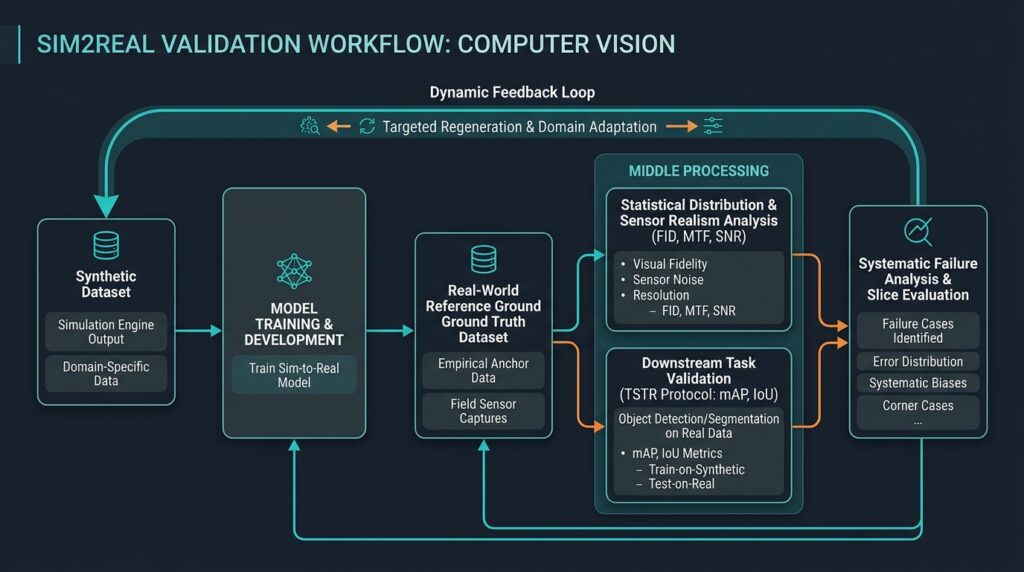
Technical workflow diagram of Sim2Real validation architecture linking synthetic datasets to real-world ground truth, distribution checks, and task evaluation.
Figure 1: The closed-loop Sim2Real validation workflow. Synthetic datasets are continuously evaluated against an empirical ground-truth anchor, feeding diagnostic errors back into simulation.


What Should You Validate in a Synthetic Dataset?

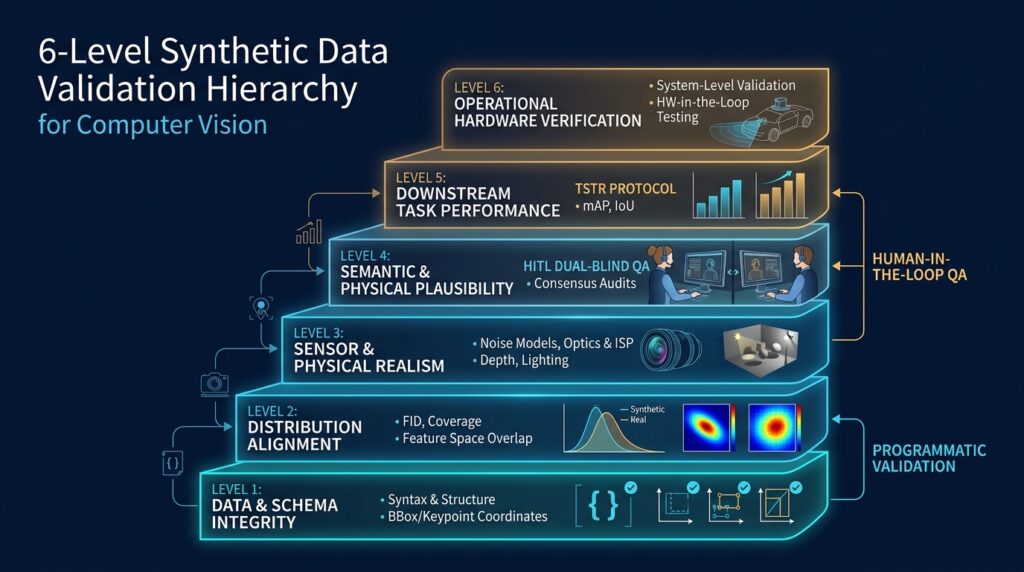
A practical synthetic-data audit can be organized into six validation levels, moving from basic data integrity to real-world model and hardware performance:


    1. Level 1: Data and Schema Integrity (Automated validation of label syntax, coordinate boundaries, parent-child class ontologies, and tracking ID consistency across frames).
    2. Level 2: Distribution Alignment (Statistical feature analysis via Fréchet Inception Distance, feature-space coverage metrics, and scenario-frequency balance).
    3. Level 3: Sensor and Physical Realism (Quantitative verification of noise profiles, optical distortion, ISP response curves, and temporal motion blur).
    4. Level 4: Semantic and Physical Plausibility (Human-in-the-loop review identifying physically impossible scenes, invalid object interactions, and guideline ambiguities).
    5. Level 5: Downstream Task Performance (Benchmarking via Train on Synthetic, Test on Real protocols to measure real-world mAP, IoU, and tracking accuracy).
    6. Level 6: Operational Hardware Verification (Evaluating edge latency, memory constraints, and runtime stability on the actual deployment hardware).


Distribution-Level Validation


What does FID tell you?
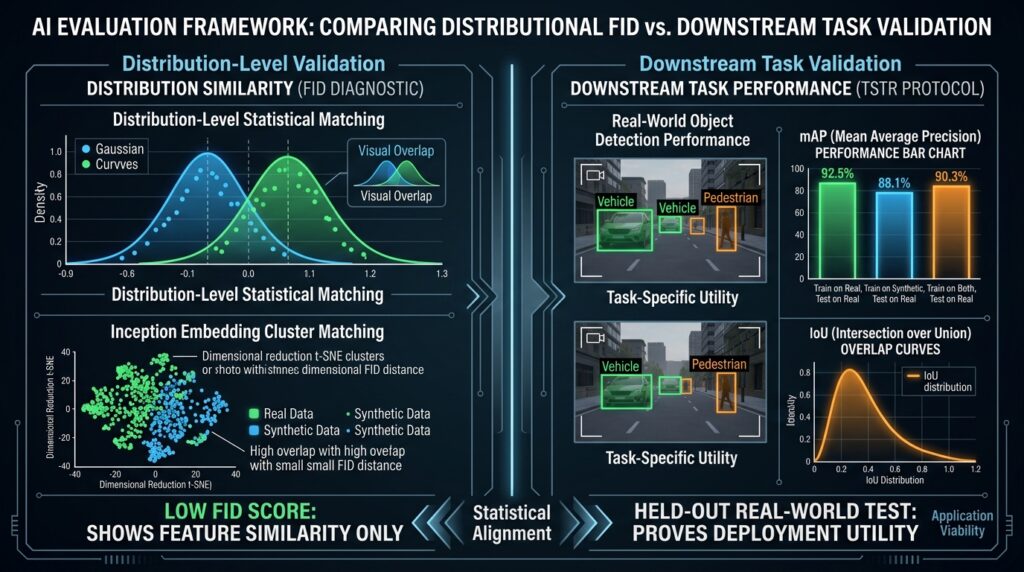
FID measures the distance between feature distributions extracted from real and synthetic images. A lower score indicates greater similarity under the feature representation used to calculate the metric (typically a pre-trained Inception-v3 network).


What does FID not tell you?
It does not establish that a model trained on the synthetic dataset will perform well on downstream real-world tasks.

The FID formula in plain text:


FID(x,y) = ||mu_x – mu_y||^2 + Tr(Sigma_x + Sigma_y – 2(Sigma_x * Sigma_y)^(1/2))


In this equation, mu_x and mu_y represent the mean feature vectors of the real and synthetic distributions, while Sigma_x and Sigma_y represent their covariance matrices. The Tr denotes the trace operation.


FID provides a useful distribution-level comparison signal, but two datasets can have a low FID score while still exhibiting critical semantic differences that degrade task accuracy. Furthermore, FID relies on Gaussian distribution assumptions that may be inaccurate for complex multimodal datasets. Crucially, FID is dependent on the feature representation used to compute it; an ImageNet-trained feature extractor may not capture the characteristics that matter most in specialized domains such as medical imaging, industrial inspection, or spatial LiDAR perception.

Because of these limitations, robust evaluation frameworks supplement FID with additional distribution-level checks, including feature-space precision and recall metrics, classifier-based two-sample tests, coverage analysis, and scenario-frequency audits.


Sensor-Level Validation

Sensor-level validation asks whether the simulated sensor behaves sufficiently like the physical sensor for the characteristics that matter to the target task.

Typical checks include:

  • Noise profiles
  • Chromatic aberration
  • Lens distortion
  • Color response curves
  • Temporal behavior
  • Motion characteristics

Engineers can compare responses to standardized calibration targets (such as checkerboards or color charts) in both the physical sensor and simulated sensor pipeline. By measuring the Modulation Transfer Function (MTF) and the Signal-to-Noise Ratio (SNR) in both domains, teams can quantify specific aspects of the sensor gap.


Task-Level Validation and the TSTR Protocol


What is TSTR?
Train on Synthetic, Test on Real (TSTR) evaluates whether a model trained using synthetic data can perform effectively on an independently held-out real-world dataset.

To evaluate downstream utility rigorously, engineering teams implement structured experimental protocols comparing synthetic and empirical datasets across four configurations:


Training ConfigurationTest DatasetEvaluation ProtocolWhat the Experiment Measures
Real Data OnlyReal HoldoutTRTR (Train Real, Test Real)Empirical performance baseline
Synthetic Data OnlySynthetic HoldoutTSTS (Train Synthetic, Test Synthetic)In-domain simulation performance
Synthetic Data OnlyReal HoldoutTSTR (Train Synthetic, Test Real)Direct Sim2Real transfer capability


The key comparison is not simply whether synthetic data produces good performance in simulation, but whether it improves or preserves performance on an independently held-out real-world dataset relative to a real-data baseline. Comparing the Mixed Training Protocol (Real + Synthetic) against the Real Only baseline provides a particularly important practical comparison: it demonstrates whether synthetic expansion actively enhances model robustness or merely adds redundant compute overhead.


Task-level evaluation measures specific downstream metrics across these experimental configurations, including mean Average Precision (mAP) for detection, mean Intersection over Union (mIoU) for segmentation, and Multiple Object Tracking Accuracy (MOTA) and IDF1 scores for tracking sequences.


Infographic comparing distribution-level Fréchet Inception Distance (FID) feature matching against downstream task performance benchmarks under TSTR.
Figure 2: Distribution-level FID feature matching versus downstream task performance. Lower FID serves as a diagnostic signal but does not guarantee real-world mAP accuracy.


Why Real-World Ground Truth Is the Validation Anchor


Why is real-world ground truth necessary?

Because synthetic data intended for physical deployment must ultimately be evaluated against representative physical-world observations. A carefully curated real-world reference set provides the empirical baseline against which synthetic-data utility and Sim2Real transfer can be measured.


Building Representative Reference Datasets

Building this reference dataset is a demanding engineering effort. The reference dataset must cover the operational distribution: lighting variations, weather conditions, specific sensor configurations, diverse object states, and rare edge cases. It must be sampled strategically to ensure that it represents the true operational design domain rather than just the most common scenarios. A carefully curated, diverse, accurately annotated real-world evaluation set can provide substantially more validation value than a much larger but redundant random sample.

Multimodal Ground Truth for Complex Vision Systems

Modern robotics and autonomous systems rely on multiple sensor modalities to perceive their environment. Validating synthetic datasets for these systems requires multimodal ground truth, including 3D LiDAR point clouds, radar cross-sections, and temporal video tracking data.


Different modalities require distinct ground-truth representations. In a camera image, a bounding box is defined by 2D pixel coordinates. In a LiDAR scan, objects are defined by 3D cuboids that capture spatial volume, heading, and velocity. Validating a synthetic sensor fusion dataset requires ensuring strict spatial and temporal consistency across these representations. If a synthetic camera frame depicts a pedestrian stepping into a crosswalk, the corresponding LiDAR measurements should be temporally and spatially consistent with the camera observation according to the simulated sensor timing and coordinate model. Establishing accurate real-world references for these complex scenarios is critical. For more information on handling spatial data, review our 3D point cloud annotation capabilities.

Human-in-the-Loop QA for Synthetic Data Validation

Automated metrics measure what has been explicitly programmed. Human review provides a vital validation layer by assessing whether a generated scene is semantically coherent and physically plausible.


Crucially, HITL review complements, rather than replaces, quantitative real-world model evaluation: human reviewers assess plausibility and semantic quality, while held-out real-world benchmarks measure actual transfer.

What Human Review Catches

A synthetic generation pipeline might render a vehicle. An automated bounding box verification script will confirm that the box accurately encloses the generated pixels. However, a human reviewer can quickly spot whether the vehicle is rendered without wheels, floating above the road surface, or intersecting with a nearby structure. Human review serves as a physical-plausibility and semantic-quality filter, catching anomalies when a simulator produces scenes that are computationally valid but physically impossible.

How to Structure HITL Review

Human-in-the-loop validation relies on structured workflows to ensure objectivity and precision. A useful methodology is independent dual review, where multiple annotators independently verify samples generated by the synthetic pipeline. By hiding the annotations of the first reviewer from the second reviewer, the workflow can reduce confirmation bias. Consensus audits are then used to measure inter-annotator agreement and identify visually ambiguous samples.

Programmatic QA Before Human Review

Before data reaches human reviewers, it must pass through programmatic schema validation. These automated checks verify label formatting, ontology compliance, spatial consistency, and temporal continuity. It ensures that bounding boxes do not exceed image dimensions, that parent-child class hierarchies are respected, and that object track IDs do not spontaneously change between sequential frames.

Measuring Reviewer Agreement

To quantify verification quality and ground-truth clarity, teams employ structured statistical metrics:

  • Categorical agreement: Fleiss’ Kappa is used to evaluate how consistently multiple reviewers assign the same class label to an instance.
  • Spatial agreement: Calibrated Intersection over Union (IoU) measurements and boundary metrics quantify agreement for bounding boxes and segmentation masks.

Handling Ambiguous Cases

The validation process will inevitably uncover scenarios that defy easy categorization, such as a vehicle heavily occluded by fog. Ambiguous cases are documented for ontology refinement, prompting the engineering team to clarify whether classes need adjustment. Teams looking to establish robust review pipelines can leverage specialized image annotation services to manage these workflows.


Diagram illustrating the 6-Level Synthetic Data Validation Hierarchy spanning schema integrity, distribution alignment, sensor realism, HITL plausibility, task metrics, and hardware testing.
Figure 3: The 6-Level Synthetic Data Validation Hierarchy for computer vision, integrating programmatic schema audits, HITL semantic review, and TSTR model benchmarking.


A Practical Synthetic Data Validation Workflow

To execute validation systematically across production cycles, engineering teams should follow a structured nine-step operational workflow:


  1. Define the Operational Design Domain (ODD): Document environmental boundaries, lighting ranges, sensor setups, object classes, and target failure modes.
  2. Construct the Real-World Reference Set: Curate and annotate a high-variance empirical dataset to serve as the definitive evaluation benchmark.
  3. Audit Data and Schema Integrity: Programmatically verify syntax, bounding box coordinates, segmentation polygons, and class taxonomy formatting.
  4. Evaluate Distribution and Scenario Alignment: Compute FID, feature-space coverage, and class distribution frequencies against empirical reference baselines.
  5. Analyze Sensor-Level Discrepancies: Benchmark simulated sensor noise, optical distortion, and ISP transfer functions against physical camera profiles.
  6. Execute Physical and Semantic HITL QA: Deploy independent human verification to filter out physically impossible renders and resolve edge-case ambiguities.
  7. Train Baseline and TSTR Experimental Models: Train benchmark models across Real Only, Synthetic Only, and Mixed datasets to isolate transfer characteristics.
  8. Perform Systematic Failure Analysis: Conduct confusion-matrix audits and slice-based evaluations on real-world holdout data to identify residual domain gaps.
  9. Iterate Generation Parameters and Re-benchmark: Feed diagnostic failure modes back into the simulation pipeline, regenerate targeted data batches, and re-validate.


Closing the Loop: From Validation Back to Dataset Engineering

Validation is not the final gate in the synthetic-data pipeline. It is the feedback mechanism that tells the generation team what to change.


Validate → Diagnose → Modify → Regenerate → Retrain → Revalidate


For example, if a model consistently misses pedestrians at night on the real-world holdout set, failure analysis may reveal missing lens bloom, insufficient reflective clothing variation, or another gap in the synthetic scenario.


Each validation cycle produces actionable diagnostic information: which scenarios transfer well, which sensor characteristics are poorly modeled, and which edge cases remain underrepresented. Armed with these specific insights, the simulation team can adjust their environmental variables, alter their sensor profiles, and generate a new batch of highly targeted training data before retraining via our integrated model training workflows.


How LabelOps Supports Synthetic Data Validation


Synthetic-data validation depends on the quality of the real-world reference data used to measure transfer. LabelOps supports this layer through enterprise annotation and dataset-engineering workflows for complex computer vision applications.


Our capabilities include:

  • Multimodal ground-truth creation: High-precision annotation for 3D LiDAR cuboids, sensor fusion alignment, and temporal video tracking.
  • Hierarchical ontology design: Managing multi-tier class structures and resolving edge-case ambiguities.
  • Structured HITL QA: Dedicated Computer Vision Engineers and QA Leads enforcing rigorous consensus and statistical agreement.
  • Secure enterprise data workflows: Controlled environments incorporating role-based access control and data security protocols.


The objective is straightforward: provide the accurately annotated empirical reference data needed to determine whether synthetic data improves performance in the target domain.


Does Your Synthetic Data Transfer to the Real World?

Synthetic data becomes valuable when its contribution can be demonstrated against representative physical-world performance. A structured validation framework provides the evidence needed to identify gaps, refine the generation pipeline, and measure whether synthetic data improves the target computer vision system.

Explore LabelOps Dataset Engineering Capabilities


Frequently Asked Questions

  1. What is synthetic data validation?
    Synthetic data validation is the systematic process of evaluating generated data to determine how effectively it transfers to real-world applications. It involves statistical distribution checks, sensor-level comparisons, and evaluating the performance of machine learning models on empirical reference data.


  1. What is the difference between synthetic data generation and synthetic data validation?
    Synthetic data generation focuses on creating artificial data through 3D simulation, procedural rules, or neural rendering. Synthetic data validation focuses on measuring whether that generated data accurately reflects real-world sensor characteristics and improves downstream model performance on physical tasks.


  1. What is the Sim2Real domain gap?
    The Sim2Real domain gap is the discrepancy in statistical distribution and visual appearance between a simulated environment and the physical world. This gap is caused by simulation artifacts, inaccurate sensor modeling, and differences in scenario coverage, which prevent models trained in simulation from performing well on real-world data.


  1. How do you measure synthetic data quality?
    Synthetic data quality is measured through a combination of programmatic schema validation, statistical distribution metrics, and human-in-the-loop review. A particularly important practical measure is evaluating downstream model performance against a held-out, highly accurate real-world evaluation set using protocols such as TSTR.


  1. What is FID and why is it not enough for synthetic data validation?
    Fréchet Inception Distance (FID) is a metric used to compare the statistical similarity of feature distributions between synthetic and real images. While it provides a useful diagnostic signal, it assumes a Gaussian distribution of features and cannot verify whether the synthetic data contains the correct semantic information necessary for downstream task performance.


  1. How does TSTR validate synthetic data?
    Train on Synthetic, Test on Real (TSTR) trains a computer vision model exclusively on synthetic data and benchmarks its accuracy (mAP, IoU) on an independently held-out real-world dataset. Comparing TSTR results against a real-data baseline reveals how effectively the synthetic features transfer to reality.


  1. Why is real-world ground truth needed for synthetic data?
    Real-world ground truth serves as the empirical anchor for evaluating synthetic datasets intended for deployment. Without a representative, accurately annotated collection of real-world data, teams have no baseline to prove that their synthetic data actually improves model performance in physical deployment environments.


  1. What is human-in-the-loop validation for synthetic data?
    Human-in-the-loop validation involves expert reviewers analyzing synthetic samples and empirical reference data to identify semantic errors, physical implausibilities, and ontology mismatches that automated scripts cannot detect. This process includes edge-case review and inter-annotator agreement audits to ensure the dataset meets project standards.


Why More Training Data Won’t Fix Your Model: How Structured Variance and Precision Annotation Drive Computer Vision Performance

How modern computer vision architectures encounter validation plateaus from redundant data, why structured variance dictates real-world inference accuracy, and how managed data operations power production AI datasets.

Key Takeaways

      • More data is not inherently better data. When a computer vision model stalls at an 80% to 85% Mean Average Precision (mAP) plateau, adding redundant baseline frames provides diminishing informational returns while consuming GPU compute.
      • Structured variance defines the “right quantity.” Breaking through validation plateaus requires deliberate coverage of the statistical long tail: rare lighting, heavy occlusions, oblique camera angles, and subtle morphological defects.
      • Workflow limitations introduce systemic ground-truth noise. Clumsy labeling interfaces and uncalibrated workflows cause polygon vertex drift, bounding box clipping, and coordinate errors that degrade neural network training.
      • Complex AI architectures demand modality-native precision. Production computer vision requires native tooling support for 9-parameter 3D LiDAR cuboids, 3D point clouds, camera-to-LiDAR calibration matrices (K[R∣t]), temporal video multi-object tracking (MOT), and hierarchical ontologies.
      • Frontier models require multimodal data partnerships. Building next-generation foundation models, Vision-Language Models (VLMs), and Vision-Language-Action (VLA) architectures demands specialized dataset curation spanning video, 3D point clouds, LiDAR, audio, text, sensor fusion, and volumetric DICOM medical imaging.
      • Dataset engineering requires CV Engineers and QA Leads. High ground-truth accuracy is achieved when machine learning teams collaborate directly with dedicated Computer Vision Engineers and QA Leads who calibrate ontologies, write programmatic schema validation tests, and enforce statistical consensus.
      • Enterprise data governance is non-negotiable. For engineering teams across the US and Europe, data operations must enforce GDPR-aware data handling, HIPAA-aligned workflows where healthcare requirements apply, secure cloud bucket syncing (AWS S3, GCS, Azure), and documented data-retention and secure deletion procedures.
      • Frontier AI expands the data engineering challenge. Next-generation Vision-Language Models (VLMs) and Vision-Language-Action (VLA) systems require structured datasets combining 3D LiDAR, multi-sensor calibration, continuous video, text, audio, and volumetric DICOM imaging.


The question in enterprise computer vision is not whether more training data helps. It often does. The question is whether the next million examples add new information, or simply more copies of what the model already knows.

When a computer vision model plateaus during validation testing (for instance, when Mean Average Precision stalls around 82%), the instinctive reaction of many engineering teams is to double the annotation budget and label another million frames.

In production computer vision, this can quickly become an expensive and inefficient approach.

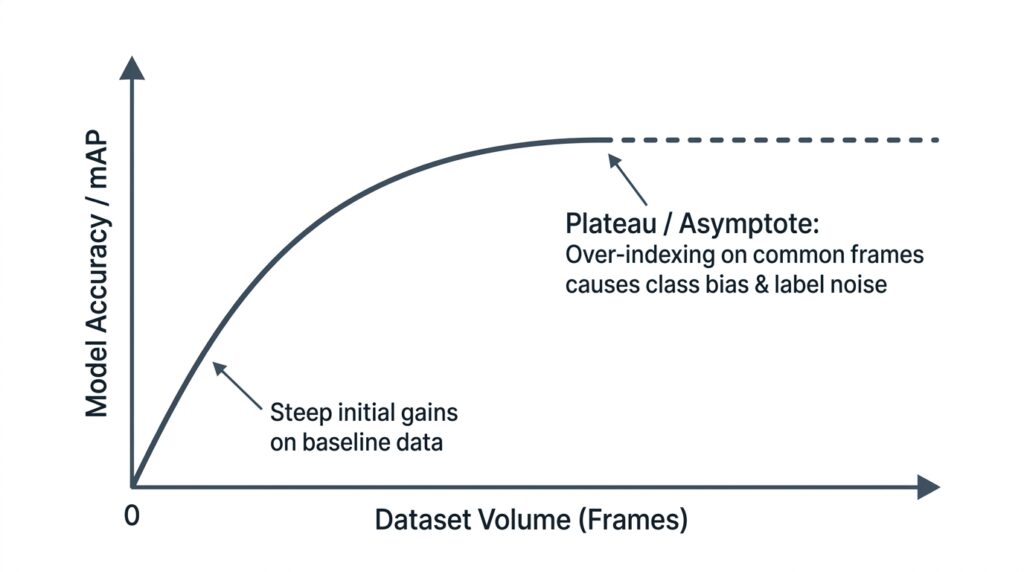
Modern AI architectures suffer from diminishing returns when fed redundant, uncurated visual samples. Annotating one million near-identical frames from a clear, well-lit manufacturing line adds very little new information to the dataset. Over-indexing on common, easy data can skew class distributions and induce model bias, degrading inference accuracy when the deployed system encounters difficult real-world edge cases.

The key to crossing critical accuracy and localization thresholds is not infinite annotation volume. It is identifying and labeling the right quantity of high-quality data engineered with structured variance.


1. Why More Annotation Data Does Not Always Improve Model Performance

Why does model performance plateau despite expanding training dataset volume?

In supervised machine learning, models learn representations by minimizing empirical risk across a training distribution. When a dataset is expanded simply by scraping or recording more baseline data, the incoming distribution is heavily skewed toward nominal, frequently occurring patterns.

Graph showing the law of diminishing returns in data annotation and AI model performance where redundant frames cause validation plateaus
Figure 1: The law of diminishing returns in machine learning data annotation. Over-indexing on common, homogeneous frames leads to validation plateaus, class imbalance, and compounding label noise.

Adding raw volume without structured variance introduces three distinct engineering liabilities into the data pipeline:

    1. Diminishing Informational Value on Common Classes: For samples the model already predicts with high confidence, additional near-duplicates contribute relatively little new loss signal during backpropagation. Compute cycles continue to be spent on samples that provide minimal gradient updates compared with harder or previously underrepresented examples.
    2. Exacerbated Class and Feature Imbalance: In real-world operational environments, nominal conditions outnumber edge cases by orders of magnitude. Mass data collection inflates the denominator of majority classes, causing the optimization landscape to favor dominant features while penalizing rare, safety-critical classes.
    3. Compounding Annotation Noise: As dataset volume scales into millions of frames, maintaining quality across distributed labeling pools becomes difficult. Published research on machine learning benchmarks (such as Northcutt et al.) demonstrates that uncurated labeling pipelines frequently introduce substantial label-error rates. When labeling millions of redundant frames, the absolute volume of erroneous annotations can easily surpass the volume of genuine edge cases in the training loss function.

To overcome a model plateau, engineering teams must stop treating data annotation as an uncurated volume pipeline. High performance requires identifying the statistical boundaries where the model is uncertain and curating data specifically to resolve that uncertainty.


2. What Does the “Right Quantity” of Training Data Mean?

How do ML teams determine the right quantity of training data?

The right quantity is not an arbitrary volume metric. It is the minimal, statistically representative volume of labeled samples required to cover the operational variance of your target deployment environment.

High-performance AI requires structured variance.

What is Structured Variance in Computer Vision?

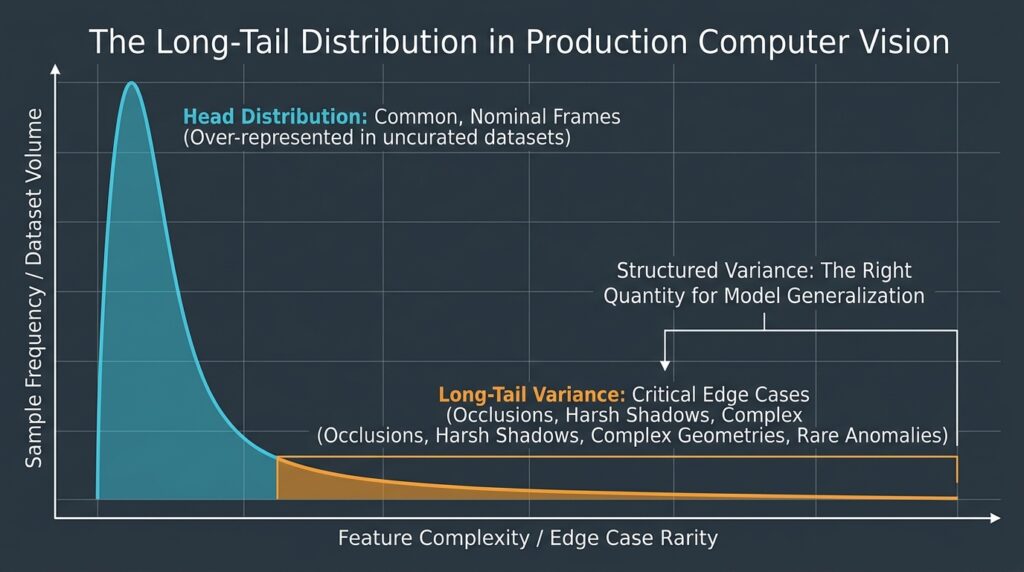
Structured variance is the deliberate, representative inclusion of training examples that capture meaningful operational differences in environmental lighting, occlusion dynamics, perspective scale, atmospheric noise, and physical object morphology. Rather than expanding dataset volume through homogeneous samples, structured variance prioritizes informational density across the statistical long tail to improve model generalization on real-world edge cases.

Graph showing the long-tail distribution in production computer vision datasets where head data is over-represented and structured variance captures critical edge cases
Figure 2: The long-tail distribution in production computer vision. Over-indexing on common, nominal frames provides minimal new information, while structured variance captures rare lighting, heavy occlusions, and critical edge cases.


Optimizing for the right quantity requires replacing blind data ingestion with targeted variance curation across five core operational dimensions:

Dimension of VarianceRedundant Baseline DatasetsTargeted “Right Quantity” Datasets
Photometric ProfilesUniform, midday overhead lightingSpecular window glare, low-angle sunset backlight, sodium flicker
Occlusion DynamicsFully visible, isolated subjects40% to 85% partial occlusions, inter-object masking, structural cutoffs
Scale and PerspectiveStandardized, eye-level camera anglesSteep oblique angles, high-mounted fisheye feeds, extreme closeups
Environmental NoiseClear indoor conditions, pristine floorsIndustrial steam, airborne dust, heavy ground shadow, rain streaks
Morphological VarianceBrand-new, undamaged equipmentScuffed surfaces, bent pallet corners, irregular rust patterns


When an ML team curates datasets based on variance density rather than raw volume, model training converges faster, storage overhead drops, and edge-case validation metrics improve significantly.


3. Why Complex Computer Vision Requires Precision Annotation Tooling

Annotating complex edge-case frames requires moving beyond rudimentary open-source labeling tools. When annotation tasks become geometrically or temporally complex, the annotation environment directly affects ground-truth quality, and therefore the quality of the training signal reaching the model.

As computer vision architectures progress from basic 2D bounding boxes to spatial perception and embodied robotics, annotation tools must natively support advanced geometric and temporal paradigms.

2D Polygon & Instance Segmentation

2D instance segmentation requires delineating individual object contours with high-precision polygon boundaries. Clumsy user interfaces cause annotator fatigue, leading to loose vertices, boundary clipping, and background bleed:

    • Pixel-Level Boundary Refinement: Delineating complex, irregular contours (such as micro-cracks in manufacturing components or cell boundaries in pathology) with zoom-independent polygon interpolation.
    • Polyline Delineation: Tagging continuous structural curves, lane boundaries, and thin wiring harnesses where area-based segmentation masks fail to capture millimeter-level structural tolerances.
    • Keypoint and Skeletal Pose Estimation: Landmark coordinate localization across joint nodes for biomechanical analysis, ergonomic safety monitoring, and robotic pick-and-place manipulation.

3D LiDAR & Point Cloud Annotation: 9-Parameter Bounding Cuboids

3D point cloud annotation is the process of labeling three-dimensional spatial returns captured by LiDAR, radar, and depth sensors. Operating in 3D metric space requires sophisticated camera projection and spatial manipulation tools:

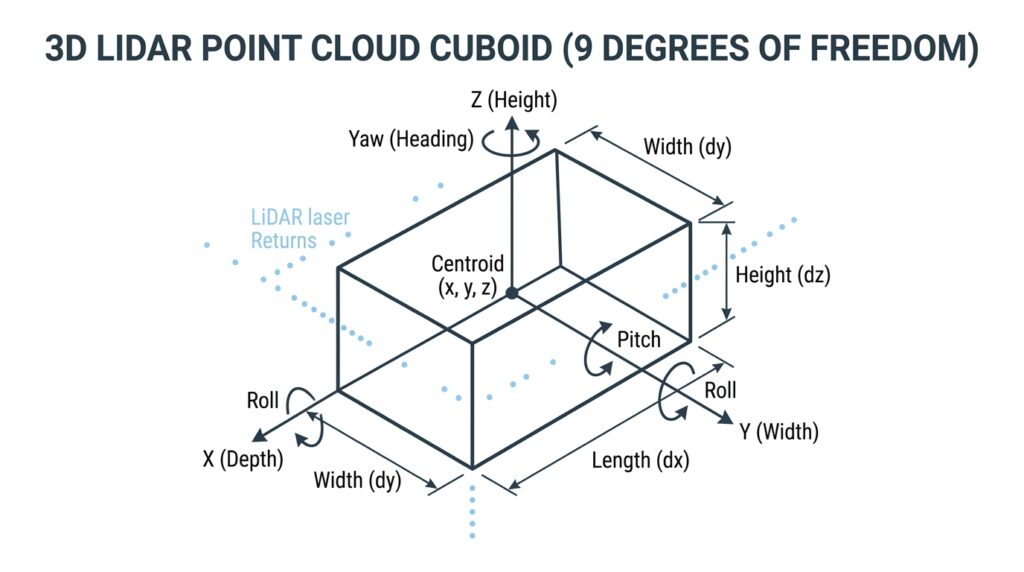
    • 9-Parameter Bounding Cuboids: Enclosing 3D point clusters with nine primary parameters: three spatial centroid coordinates(x,y,z), three physical dimensions (length, width, height), and three Euler rotation angles (yaw, pitch, roll).
    • Intensity and Return-Echo Filtering: Visualizing laser return reflectivity to isolate lane markings, retro-reflective safety tape, and structural boundaries within sparse point clouds.
    • Point-Level Semantic Segmentation: Classifying millions of individual laser returns by point categories (ground plane, drivable surface, curb, structural obstacle) to train volumetric neural networks.
3D LiDAR point cloud bounding cuboid diagram illustrating 9 Degrees of Freedom with spatial coordinates, metric dimensions, and rotation angles
Figure 3: 3D LiDAR point cloud bounding cuboid geometry (9 Degrees of Freedom). Capturing metric centroid coordinates (x, y, z), dimensions (dx, dy, dz), and Euler rotation angles (yaw, pitch, roll).

Multi-Sensor Fusion & Calibration

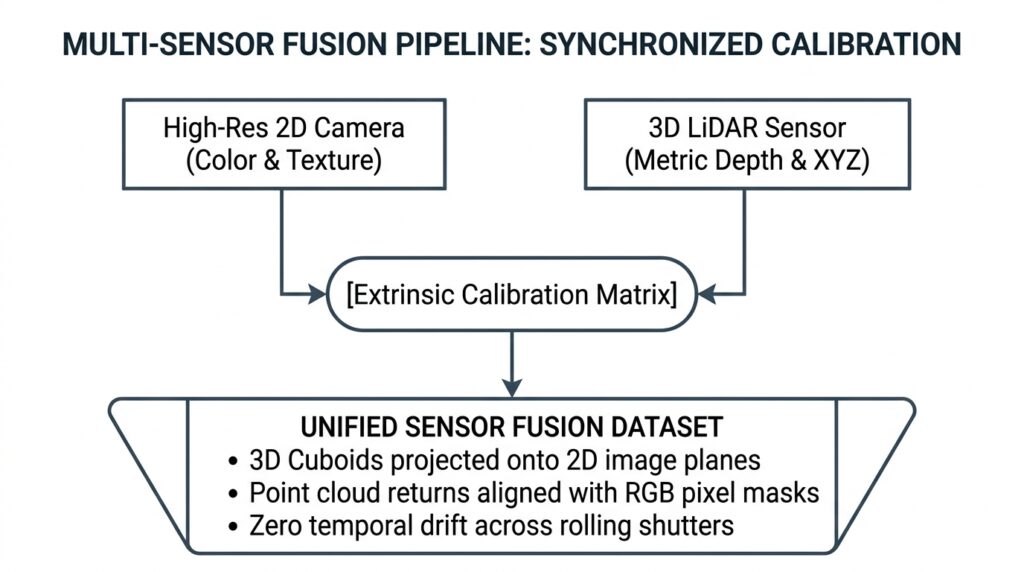
Sensor fusion annotation involves aligning and labeling data across multiple synchronized sensor streams, such as 2D RGB perspective cameras, 3D LiDAR sweeps, and radar velocities:

    • Extrinsic and Intrinsic Matrix Calibration: Utilizing(K[R∣t]) camera calibration matrices to project 3D LiDAR cuboids directly onto 2D image planes, ensuring zero geometric parallax between sensor streams.
    • Bird’s Eye View (BEV) Projection: Unifying multi-camera perspective streams into a top-down spatial grid, eliminating camera distortion across vehicle blind spots and overlapping fields of view.
    • Radar Velocity Correlation: Synchronizing sparse radar micro-Doppler velocity vectors with visual bounding boxes for robust tracking in low-visibility environments.
Multi-sensor fusion pipeline flowchart showing high-resolution 2D camera and 3D LiDAR data synchronized through an extrinsic calibration matrix
Figure 4: Multi-sensor fusion pipeline. Synchronizing 2D perspective cameras with 3D LiDAR point clouds via extrinsic calibration matrices for unified ground-truth dataset generation.

Temporal Video Annotation & Multi-Object Tracking (MOT)

Temporal video tracking extends labeling across continuous frame sequences, capturing movement vectors, acceleration profiles, and state transitions:

    • Persistent Instance IDs: Maintaining continuous object identity across thousands of video frames, even when subjects undergo temporary or prolonged occlusion behind static infrastructure.
    • Spline Trajectory Interpolation: Automatically calculating smooth motion paths between verified keyframes, reducing manual keypoint entry while logging accurate heading vectors.
    • Behavioral State Tagging: Annotating action boundaries (such as “forklift turning”, “operator reaching”, “hazard perimeter entered”) to train foundation models and Vision-Language-Action (VLA) architectures.

Hierarchical and Nested Classification

Hierarchical classification replaces flat, ambiguous label lists with recursive parent-child ontological trees:

    • Multi-Tier Classification Trees: Tagging objects through recursive taxonomic layers (e.g. Equipment → Material Handling → Forklift → Counterbalanced High-Lift).
    • Dynamic Conditional Attributes: Configuring workflow interfaces where secondary prompts trigger only based on primary selections (e.g. selecting Fastener == Bolt dynamically displays attributes for Thread Pitch, Grade Rating, and Surface Oxidation).
    • Ontological Consistency: Eliminating labeler confusion by embedding strict visual reference guides directly within the annotation interface.

4. How AI-Assisted Pre-Labeling Improves Data Operations

High annotation throughput and ground-truth precision are not mutually exclusive when AI foundation models are integrated thoughtfully into the labeling loop.

Rather than relying on manual pixel tracing for every standard shape, modern dataset pipelines leverage foundation models, such as the Segment Anything Model (SAM), alongside automated bounding box trackers to generate initial candidate geometries:

    1. Prompt-Based Mask Generation: Annotators provide bounding box prompts or single-click points, allowing SAM to instantiate high-resolution segmentation masks instantly.
    2. Automated Keyframe Interpolation: For continuous video tracking, predictive tracking algorithms interpolate object paths across linear motion sequences between verified keyframes.
    3. Human-in-the-Loop Verification: AI pre-labeling never bypasses human validation. Human annotators inspect every generated boundary, correct edge artifacts, resolve boundary clipping, and assign nuanced taxonomic attributes.


By handling the mechanical burden of initial geometry drafting, AI assistance significantly reduces annotator cognitive fatigue. Annotator focus shifts entirely to where human judgment is irreplaceable: diagnosing complex edge cases, adjudicating ambiguous boundaries, and enforcing strict ground-truth fidelity.


5. How LabelOps Builds Closed-Loop Annotation QA Pipelines

How should annotation quality be audited in production machine learning?


Quality control cannot be an afterthought conducted via casual manual spot-checks. Reliable ground truth requires a closed-loop quality assurance pipeline integrated directly into the annotation operation:


Flowchart illustrating data annotation services through a closed-loop quality assurance workflow, including dual-blind consensus, lead QA review, and automated schema linting
Figure 5: The closed-loop quality assurance workflow in data annotation. Structured pipeline from raw ingest through AI-assisted labeling, dual-blind consensus audits, quarantine recalibration, and automated syntax linting.


  1. Dual-Blind Calibration Sprints: When establishing a new dataset ontology, sample batches are labeled independently by multiple annotators without visibility into each other’s outputs. Discrepancies are surfaced automatically to measure Fleiss’ Kappa(κ) and align annotator interpretation before scaling production.
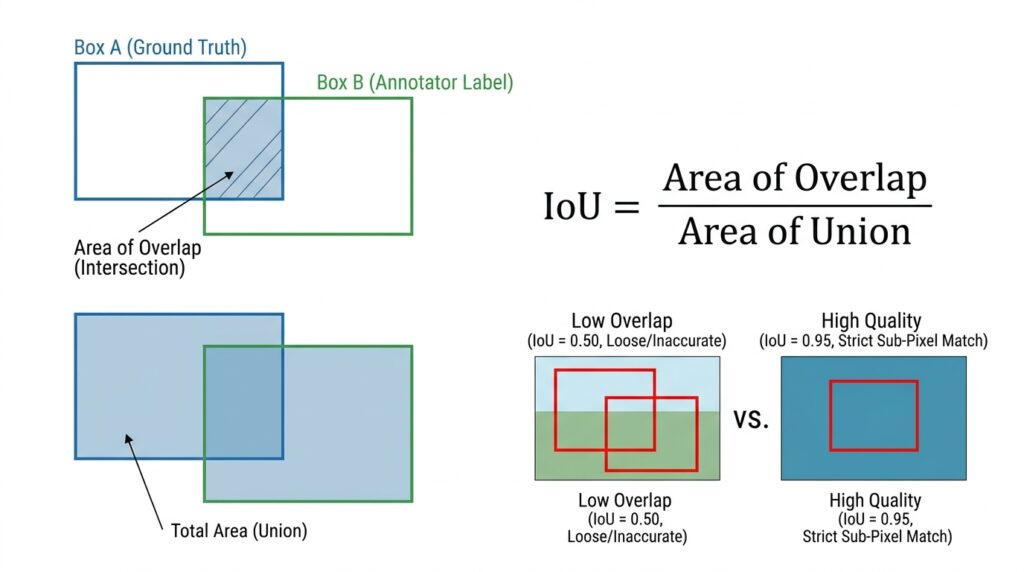
  2. Project-Calibrated Statistical Consensus (IoU): LabelOps applies project-calibrated Intersection-over-Union (IoU) acceptance thresholds based on annotation modality and downstream model requirements. For rigid 2D and 3D bounding geometries, projects often establish acceptance thresholds in the IoU≥0.90–0.95 range, while complex polygon segmentation tasks use tailored thresholds (such as IoU≥0.85–0.90) calibrated to boundary intricacy and model sensitivity.


IoU = (Area of OverlapArea of Union) ⁄ (Area of Overlap)


Intersection over Union (IoU) consensus diagram showing area of overlap divided by area of union for bounding box and polygon annotation accuracy
Figure 6: Intersection-over-Union (IoU) consensus and boundary accuracy in data annotation. Mathematical formulation comparing low overlap (IoU = 0.50) against strict enterprise ground-truth alignment (IoU ≥ 0.90–0.95).


  1. Active Batch Quarantine: If an edge case triggers annotator variance beyond defined IoU or class ambiguity thresholds, the platform automatically quarantines the batch. A Quality Lead reviews the flagged samples, updates the central annotation manual, and propagates the corrected edge-case guidance across all annotator workstations.
  2. Automated Geometric & Schema Linting: Programmatic validation scripts run continuously before batch export. These automated checkers detect polygon self-intersections, bounding box clipping at image borders, duplicate instance IDs, and schema syntax mismatches.
  3. Domain-Qualified Escalation: Nuanced, high-stakes edge cases (such as micro-fractures in industrial components or subtle anatomical margins in medical imaging) are automatically routed to senior QA Leads and domain-qualified reviewers for final sign-off.

6. Why Frontier AI and Multimodal Systems Expand the Dataset Problem

As computer vision evolves toward Vision-Language Models (VLMs), Vision-Language-Action (VLA) systems, robotics, and multimodal foundation models, training data is no longer limited to isolated 2D images.
These systems increasingly depend on datasets that combine different forms of visual, spatial, temporal, and contextual information:
    • 3D Point Clouds and LiDAR: 3D cuboids and point-level segmentation for spatial perception and robotics.
    • Multi-Sensor Fusion: Camera, LiDAR, and radar data aligned through calibrated coordinate transformations so that observations from different sensors correspond to the same physical environment
    • Continuous Video: Multi-object tracking and temporal annotations that preserve how objects and events evolve across sequences rather than treating every frame independently.
    • Text and Audio Grounding: Video paired with transcripts, audio events, timestamps, and visual-question-answering data for multimodal understanding.
    • Medical Imaging: DICOM-based datasets requiring structured segmentation and volumetric annotations across different imaging planes.
The underlying dataset engineering problem, however, remains the same:
More data is not necessarily better data
A multimodal dataset can contain terabytes of information and still perform poorly in production if it does not represent the conditions the model will encounter. Rare sensor noise, severe occlusion, changing viewpoints, calibration differences, environmental variation, and subtle state transitions can all become sources of model failure.
This makes structured variance, annotation consistency, and dataset quality increasingly important as AI systems become more capable.
For enterprise teams building multimodal and frontier AI systems, the challenge is therefore not simply collecting larger training corpora. It is engineering datasets that are representative, precisely annotated, consistently validated, and aligned with the model’s intended operational environment.
The more capable the model becomes, the more sophisticated the data foundation needs to be.

7. How to Evaluate Enterprise Data Annotation Services for Production Computer Vision

For engineering teams evaluating external data annotation services, selecting a partner is not simply a matter of hourly cost per frame. In production computer vision, dataset quality is the outcome of the entire data operation: ontology design, workflow configuration, tooling precision, annotator expertise, QA rigor, and integration with the client’s ML pipeline.

When auditing enterprise data annotation services, ML engineering leads and technical directors should evaluate six core operational capabilities:


1. Bespoke Workflows2. CV Engineers & QA3. Enterprise Operations
  • Custom ontologies & schemas
  • Multi-sensor fusion calibration
  • Complex 3D LiDAR modalities
  • Dedicated in-house CV Leads
  • AI-assisted SAM pre-labeling
  • Fleiss’ Kappa & IoU audits
  • GDPR & HIPAA-aligned privacy
  • Direct cloud bucket / VPC sync
  • Documented purge & retention


    1. Dedicated CV Engineers and QA Leads: Does the provider assign dedicated Computer Vision Engineers and QA Leads who collaborate peer-to-peer with your ML team, calibrate guidelines, write automated validation scripts, and resolve edge-case ambiguities?
    2. Modality Competence Beyond 2D Bounding Boxes: Can the annotation environment natively handle 3D LiDAR point clouds (9-parameter cuboids), sensor fusion extrinsic calibration matrices (K[R∣t]), temporal video tracking with persistent IDs, and multi-tier taxonomies?
    3. Multimodal and Spatial Competence: Does the provider support cross-modal dataset workflows spanning 3D LiDAR point clouds, sensor fusion calibration, temporal video tracking, and multimodal text and audio alignment for advanced AI architectures?
    4. Structured Variance & Edge-Case Curation: Does the operation actively assist in identifying and prioritizing informational variance across the statistical long tail, rather than simply processing uncurated volume?
    5. Verifiable Mathematical QA: Does the service provide verifiable statistical consensus reports (Fleiss’ Kappa, calibrated IoU distributions) and automated geometric linting rather than unverified marketing claims of 99% accuracy?
    6. Enterprise Data Governance & Privacy Controls (US & EU): Does the provider maintain GDPR-aware data handling for European projects and HIPAA-aligned workflows where protected healthcare data applies, alongside role-based access controls and encrypted cloud bucket syncing (AWS S3, Google Cloud Storage, Azure Blob)?
    7. Documented Data Retention & Secure Deletion: Does the contract define documented data retention and secure deletion procedures following project completion?


This is where LabelOps takes a differentiated approach. LabelOps is not a generic, off-the-shelf software tool, nor a commodity click farm. We operate as a dedicated data annotation and dataset engineering partner powered by proprietary internal tooling, pairing client machine learning teams directly with in-house Computer Vision Engineers to deliver validated, production-ready training datasets.

Optimize Your Training Data for Real-World Inference

Stop paying for redundant data annotation that yields diminishing returns. Equip your models with the precise variance they need to succeed in production.

LabelOps combines custom platform tooling, dedicated Computer Vision engineering, AI-assisted efficiency, and multi-stage consensus QA to deliver enterprise-grade training data for production computer vision and multimodal AI.

Whether you are building autonomous perception datasets, preparing multimodal training data, or scaling annotation operations for production computer vision, our engineering team can configure a tailored data operations pipeline around your model, ontology, and quality requirements.

Request a Data Annotation Project Consultation with LabelOps →


Frequently Asked Questions About Computer Vision Data Annotation

Why does model performance plateau during validation?

Continue reading “Why More Training Data Won’t Fix Your Model: How Structured Variance and Precision Annotation Drive Computer Vision Performance”

What is Image Annotation ?


Years back, human efforts were used to carry out a lot of activities. They were needed in various sectors that use the human working capacity to carry out their businesses. Today, the world is experiencing a widespread technology revolution whereby information technology (IT) is fast dictating the pace and the scheme of events. With the use of computers, brilliant ideas have been transformed into excellent innovations like artificial intelligence and machine learning. These two innovations have made life, and business processes become easier. Machine learning and artificial intelligence rely on the use of a computing algorithm to replicate intelligent human behavior. These behaviours include automatic speech recognition, augmented reality, and neural machine translations. That said, the success of these technological innovations in various sectors led to intensive research on the use of computers to visualize and interpret images. With different software, computer vision makes an effort to activate the machine eyes to see and interpret images.

Technology has proved that computer vision can give the human race and scientists autonomous vehicles, unmanned drones, and facial recognition. However, this extraordinary development can be enjoyed with the introduction of image annotation in the technology world. Image annotation is an important task when it comes to computer vision.   As useful as this technology may be to the human race, there are lots of hidden information that are needed to be unraveled to understand its function fully and uses in the world. Therefore, today, I will be telling you all you need need to know about image annotation.

                         What is Image Annotation ?

Image annotation is an innovative computing technology where a human-powered task is used to manually identify and define regions in an image and also create a text-based description for the areas specified in the image. Image annotation catalyzes the pattern recognition process of the computer vision system when it is presented with a new image or data. The rate at which patterns or labels on images are being recognized differs. Images or data with similar labels are recognized easier and quicker than those with different labels. Image annotation technology is mostly used by artificial intelligence (AI) engineers to give information about an image for developing a computer vision model.


Different Techniques of Image Annotation


  1. 2D Bounding Box

The 2D bounding box technique is one of the significant techniques used in annotating images. In this method, annotators create a box around the object of interest at a particular frame and location. Also, you create place anchor points at the edges of each object. Many a time, the object may look the same. In this instance, you can draw boxes of all the objects in the image. Also, when there are different objects in the location, you must draw boxes around each object. For instance, if you have cars, bicycles, and pedestrians, you should draw boxes around each of them. After drawing the box, the annotator will choose labels that are a perfect fit to object in the box.

  1. 3D Bounding Box

The 3D bounding box, also known as cuboid, is a technique that is similar to the 2D bounding box. In this technique, the annotator creates a box around each image. They also place a point anchor point on the edges of each object. The boxes are created to cover a specific location and frame. However, the difference here is that the boxes can show the depth of the object been annotated.

  1. Polygon Annotation

Polygon annotation is an excellent image annotation technique annotator can use for objects that have irregular shapes and sizes. This method is useful because 2D and 3D bounding boxes can only annotate images with regular shapes. In this technique, polygons are created around the image of interest. This makes it easier to predict accurately the image’s volume and position within the polygonal space.

  1. Polylines

Polyline annotation is a fantastic annotation technique that is mainly used when you desire to make your computer vision system aware if annotating boundaries, splines, and lines. Annotators can also use the polyline technique to plan trajectories in drones. In this technique, straight or curved lines are created on images. Then the annotator would be left the option of annotating sidewalks, lanes, powerlines, and some other boundary indicators.

  1. Keypoint

Keypoint tracking is an image annotation technique that annotators can use to determine the outermost part of an object. They also use it to determine the size and position of essential parts of the object. For instance, if you are annotating a car, it vital parts like side mirrors, headlights, and wheels are determined.

  1. Semantic Segmentation

If you wish to annotate image by dividing it into different segments or regions, you can choose semantic segmentation. For example, you can annotate the image of your car pack. A typical car pack comprises of trees, grasses, and sidewalk. Each of these components is separated into different segments. Then they are annotated separately. While using a semantic segmentation technique to carry out image annotation, you may need to adjust the threshold of the semantic segmentation algorithm. This will help it annotate any kind of image you desire.


Steps in Image Annotation

  1. Analyze Project Limitations

The first step to annotate a given image is to analyze the restriction on the project. Therefore, analyzing the project give annotators an idea about the project and its constraints.

  1. Use Appropriate tools

Many tools have been made available for annotators to use. However, you need to choose the right tool for the kind of image you want to annotate. The analysis you have previously done will assist you in choosing the best tool for a specific image.

  1. Use Appropriate Technique

After you have selected the right tool, you need to employ the correct technique to annotate a particular image. This involves studying the project instruction. Images produced with the proper technique can be used as training data.

Best Company that Provide Image Annotation Service

LabelOps

LabelOps is one of the best companies that provide excellent and fantastic imaging annotating services worldwide. It has the lowest hourly rates and best accurate annotations for the best training dataset. The company has a team of experts and professionals that specializes in machine learning, artificial intelligence, and image annotation. It also has state-of-the-art facilities that are used to carry out annotating services. LabelOps is an image annotating company that is certified and provides fantastic customer support services when you consult them for image annotating services.

The company has a track record of outstanding and excellent services on its previous and ongoing contracts. Their professional services are rendered to IT customers and other stakeholders at affordable prices.

Conclusion

Image annotation is vital to artificial intelligence engineers. Today, I have discussed crucial points you need to know about Image annotation. Please read through it and get informed about the image and text-based description technology.

How cheap image annotation can be ?

The most challenging part for developing an computer vision model is preparing a high quality training data set . Is it possible to process a high quality training data set with your optimal budget ?

How cheap image annotation can be ? 

Image annotation is an emerging technology in the IT world that has received considerable attention in the last few years. Since its innovation and discovery, most image annotation companies have been offering their services at per hour charges. These services are charged at higher prices, thereby leaving out term people to understand, which is the word “cheap.” That said, there is a belief among IT customers that quality services can only be accessed at a high price. LabelOps is an image annotation company that has proved many IT customers wrong on the assertion that cheap services correspond to low-quality services. Since its inception, the company has attracted more customers based on its high-quality image annotation services at $3.5 per hour charges , where as the price in the global market varies from $7-10 per hour . This is a prove that image annotation customers can get high-quality services at lower prices. Today, I will be discussing all that LabelOps has put in place and yet offer high-quality hourly services.

  1. Its Investment and Equipment

One of the reasons why an image annotation company can be referred to as been “standard” is the massive investment in terms of facilities and equipment. There is a general belief that an image annotation company that has invested heavily in setting up its state-of-the-art facilities is expected to offer its services to clients at higher prices. This is because they will be expected to cashback the money spent in no time. Despite its massive investment in its state-of-the-art facilities, LabelOps has placed quality services above its hourly charges. This means that you will always get high-quality services at a lower hourly price. At LabelOps, we prioritize promptness and make the dedication to service our watchword. The company has developed new techniques to ensure that you get the best image annotation services at lower prices of $3.5 per hour.

  1. Location and Economy

The location of clients can sometimes increase the cost of services charged per hour by the image annotation companies. At LabelOps, we prioritize quality services and rank them higher above your location. We understand the importance of our fantastic and high-quality service to you. Hence, we ensure your location is not a barrier to giving you the best service you deserve. At LabelOps, we have developed new tactics and strategies to ensure that we remain within your reach and offer the best image annotation services to you at $3.5 per hour. LabelOps does not require your presence to get your work done. All the company needs is effective communication through cheaper communication channels.

  1. Economy

Affordability in terms of service charges is always a challenge to some image annotation clients in the developing nations. They desire to access quality annotation services at lower prices. However, most annotation companies are not sensitive to the economic realities of these clients from developing countries. At LabelOps, we place clients’ financial considerations and interests above our service charges. We understand that they desire quality services by cannot afford the prices charged by other annotation companies. Hence, we prioritize quality and superior services above other factors. When clients consult LabelOps for their image annotation services, the company has fantastic annotation tools that can cater to their annotation needs at a cheaper cost of $3.5 per hour.

  1. Workforce

Many a time, IT companies engage the services of outstanding experts and professional thereby providing their quality services at higher prices. Image annotation companies also have teams of excellent professionals and experts that are trained and certified to carry out fantastic services at high hourly rates. At LabelOps, we have a team of qualified, certified, and well-trained experts and professionals that offer excellent and quality image annotation services to clients at lower hourly prices. Our brilliant professionals are the best you can find when it comes to image annotation services in the IT industry. These professional engineers are experts in the use of various state-of-the-art annotator tools to render quality services that worth far more than the price charge per hour by the company. Their years of working experience in the image annotation services account for their abilities to know the right image annotation technique to use when you consult them for the delivery of superior and excellent image annotation services.

  1. Quality Services

Quality is a common word that is mostly used in the IT and other sectors of industrial set up. Most image annotation companies prioritize quality services at their optimum price charged per hour. They often lower their prices by restricting the client’s access to some annotation services. At LabelOps, our lower price charged at $3.5 per hour does not translate to the restriction of certain services. All our annotation services are embedded in the $3.5 per hour charged. Hence, when you consult us for your annotation services, you can be sure that you will get high-quality annotation services with the attention and services of our professionals and IT experts.

  1. Support Services

A lot of certified IT companies offer excellent support services to their clients at a higher price. This is because they pay adequate and exceptional attention to make sure the services rendered are devoid of error. However, LabelOps is an image annotator company that focuses on providing support services at lower prices. At LabelOps, we offer fantastic support services to all our clients, irrespective of their location. The company has well trained, experienced, and certified experts that provide excellent support services to clients at lower hourly prices. Our support section ensures all your complaints, inquiry, and clarifications are given prompt attention and adequately considered. Our excellent support services are rendered to clients at a lower cost of $3.5 per hour.

Conclusion


Cheaper cost of services does not correspond to low image annotation services at LabelOps. We place your desire above the revenue and other benefits. We prioritize superior and high-quality image annotation services that are second to none above gains. This attribute of LabelOps is unique among the various annotation companies. Consulting us for your image annotation services is the best action you need to take today. Test our high quality and superior services today, and you will not regret doing so.


Get Started