


How modern computer vision architectures encounter validation plateaus from redundant data, why structured variance dictates real-world inference accuracy, and how managed data operations power production AI datasets.
Key Takeaways
- More data is not inherently better data. When a computer vision model stalls at an 80% to 85% Mean Average Precision (mAP) plateau, adding redundant baseline frames provides diminishing informational returns while consuming GPU compute.
- Structured variance defines the “right quantity.” Breaking through validation plateaus requires deliberate coverage of the statistical long tail: rare lighting, heavy occlusions, oblique camera angles, and subtle morphological defects.
- Workflow limitations introduce systemic ground-truth noise. Clumsy labeling interfaces and uncalibrated workflows cause polygon vertex drift, bounding box clipping, and coordinate errors that degrade neural network training.
- Complex AI architectures demand modality-native precision. Production computer vision requires native tooling support for 9-parameter 3D LiDAR cuboids, 3D point clouds, camera-to-LiDAR calibration matrices (K[R∣t]), temporal video multi-object tracking (MOT), and hierarchical ontologies.
- Frontier models require multimodal data partnerships. Building next-generation foundation models, Vision-Language Models (VLMs), and Vision-Language-Action (VLA) architectures demands specialized dataset curation spanning video, 3D point clouds, LiDAR, audio, text, sensor fusion, and volumetric DICOM medical imaging.
- Dataset engineering requires CV Engineers and QA Leads. High ground-truth accuracy is achieved when machine learning teams collaborate directly with dedicated Computer Vision Engineers and QA Leads who calibrate ontologies, write programmatic schema validation tests, and enforce statistical consensus.
- Enterprise data governance is non-negotiable. For engineering teams across the US and Europe, data operations must enforce GDPR-aware data handling, HIPAA-aligned workflows where healthcare requirements apply, secure cloud bucket syncing (AWS S3, GCS, Azure), and documented data-retention and secure deletion procedures.
- Frontier AI expands the data engineering challenge. Next-generation Vision-Language Models (VLMs) and Vision-Language-Action (VLA) systems require structured datasets combining 3D LiDAR, multi-sensor calibration, continuous video, text, audio, and volumetric DICOM imaging.
The question in enterprise computer vision is not whether more training data helps. It often does. The question is whether the next million examples add new information, or simply more copies of what the model already knows.
When a computer vision model plateaus during validation testing (for instance, when Mean Average Precision stalls around 82%), the instinctive reaction of many engineering teams is to double the annotation budget and label another million frames.
In production computer vision, this can quickly become an expensive and inefficient approach.
Modern AI architectures suffer from diminishing returns when fed redundant, uncurated visual samples. Annotating one million near-identical frames from a clear, well-lit manufacturing line adds very little new information to the dataset. Over-indexing on common, easy data can skew class distributions and induce model bias, degrading inference accuracy when the deployed system encounters difficult real-world edge cases.
The key to crossing critical accuracy and localization thresholds is not infinite annotation volume. It is identifying and labeling the right quantity of high-quality data engineered with structured variance.
1. Why More Annotation Data Does Not Always Improve Model Performance
Why does model performance plateau despite expanding training dataset volume?
In supervised machine learning, models learn representations by minimizing empirical risk across a training distribution. When a dataset is expanded simply by scraping or recording more baseline data, the incoming distribution is heavily skewed toward nominal, frequently occurring patterns.
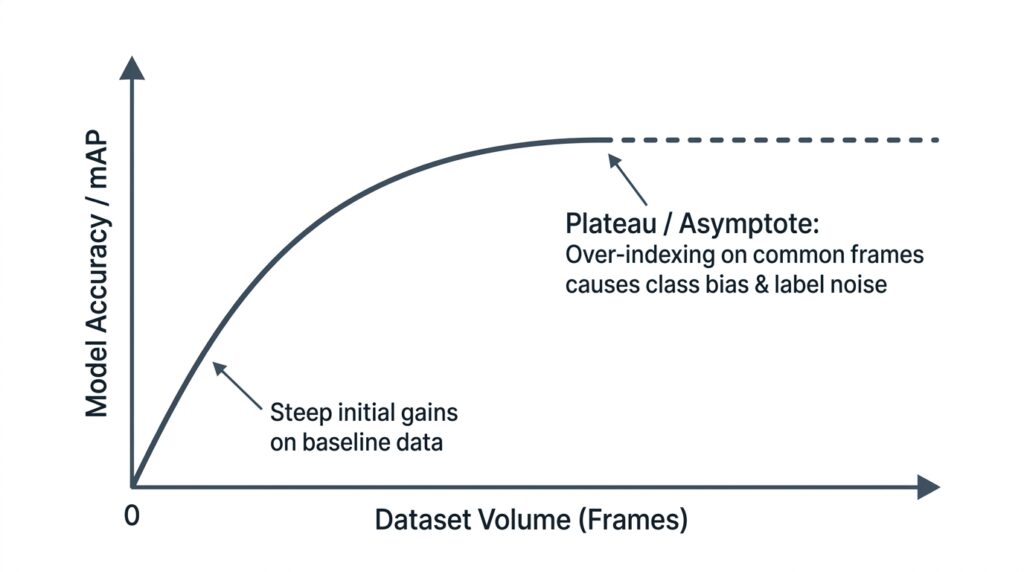
Adding raw volume without structured variance introduces three distinct engineering liabilities into the data pipeline:
- Diminishing Informational Value on Common Classes: For samples the model already predicts with high confidence, additional near-duplicates contribute relatively little new loss signal during backpropagation. Compute cycles continue to be spent on samples that provide minimal gradient updates compared with harder or previously underrepresented examples.
- Exacerbated Class and Feature Imbalance: In real-world operational environments, nominal conditions outnumber edge cases by orders of magnitude. Mass data collection inflates the denominator of majority classes, causing the optimization landscape to favor dominant features while penalizing rare, safety-critical classes.
- Compounding Annotation Noise: As dataset volume scales into millions of frames, maintaining quality across distributed labeling pools becomes difficult. Published research on machine learning benchmarks (such as Northcutt et al.) demonstrates that uncurated labeling pipelines frequently introduce substantial label-error rates. When labeling millions of redundant frames, the absolute volume of erroneous annotations can easily surpass the volume of genuine edge cases in the training loss function.
To overcome a model plateau, engineering teams must stop treating data annotation as an uncurated volume pipeline. High performance requires identifying the statistical boundaries where the model is uncertain and curating data specifically to resolve that uncertainty.
2. What Does the “Right Quantity” of Training Data Mean?
How do ML teams determine the right quantity of training data?
The right quantity is not an arbitrary volume metric. It is the minimal, statistically representative volume of labeled samples required to cover the operational variance of your target deployment environment.
High-performance AI requires structured variance.
What is Structured Variance in Computer Vision?
Structured variance is the deliberate, representative inclusion of training examples that capture meaningful operational differences in environmental lighting, occlusion dynamics, perspective scale, atmospheric noise, and physical object morphology. Rather than expanding dataset volume through homogeneous samples, structured variance prioritizes informational density across the statistical long tail to improve model generalization on real-world edge cases.
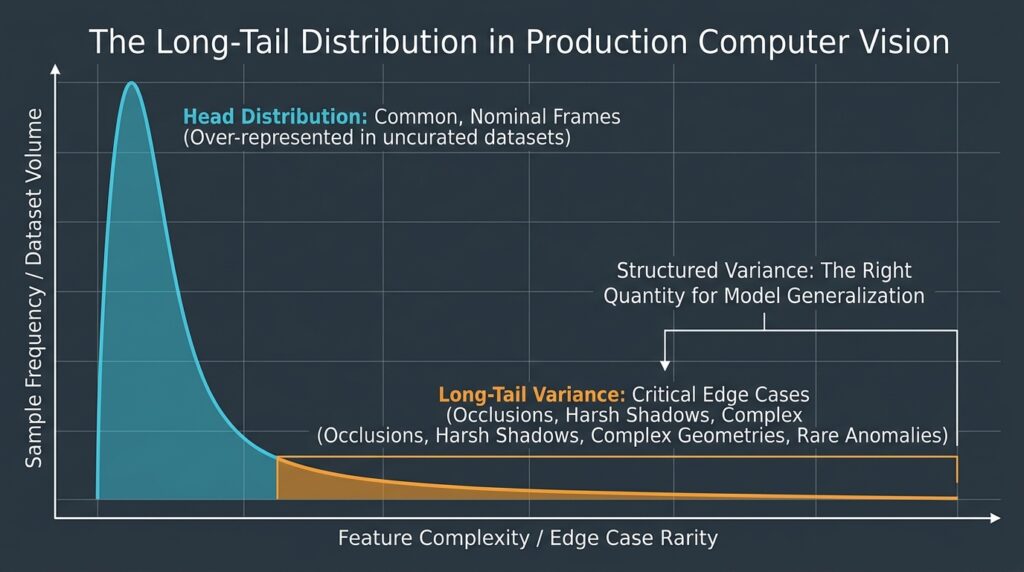
Optimizing for the right quantity requires replacing blind data ingestion with targeted variance curation across five core operational dimensions:
| Dimension of Variance | Redundant Baseline Datasets | Targeted “Right Quantity” Datasets |
| Photometric Profiles | Uniform, midday overhead lighting | Specular window glare, low-angle sunset backlight, sodium flicker |
| Occlusion Dynamics | Fully visible, isolated subjects | 40% to 85% partial occlusions, inter-object masking, structural cutoffs |
| Scale and Perspective | Standardized, eye-level camera angles | Steep oblique angles, high-mounted fisheye feeds, extreme closeups |
| Environmental Noise | Clear indoor conditions, pristine floors | Industrial steam, airborne dust, heavy ground shadow, rain streaks |
| Morphological Variance | Brand-new, undamaged equipment | Scuffed surfaces, bent pallet corners, irregular rust patterns |
When an ML team curates datasets based on variance density rather than raw volume, model training converges faster, storage overhead drops, and edge-case validation metrics improve significantly.
3. Why Complex Computer Vision Requires Precision Annotation Tooling
Annotating complex edge-case frames requires moving beyond rudimentary open-source labeling tools. When annotation tasks become geometrically or temporally complex, the annotation environment directly affects ground-truth quality, and therefore the quality of the training signal reaching the model.
As computer vision architectures progress from basic 2D bounding boxes to spatial perception and embodied robotics, annotation tools must natively support advanced geometric and temporal paradigms.
2D Polygon & Instance Segmentation
2D instance segmentation requires delineating individual object contours with high-precision polygon boundaries. Clumsy user interfaces cause annotator fatigue, leading to loose vertices, boundary clipping, and background bleed:
- Pixel-Level Boundary Refinement: Delineating complex, irregular contours (such as micro-cracks in manufacturing components or cell boundaries in pathology) with zoom-independent polygon interpolation.
- Polyline Delineation: Tagging continuous structural curves, lane boundaries, and thin wiring harnesses where area-based segmentation masks fail to capture millimeter-level structural tolerances.
- Keypoint and Skeletal Pose Estimation: Landmark coordinate localization across joint nodes for biomechanical analysis, ergonomic safety monitoring, and robotic pick-and-place manipulation.
3D LiDAR & Point Cloud Annotation: 9-Parameter Bounding Cuboids
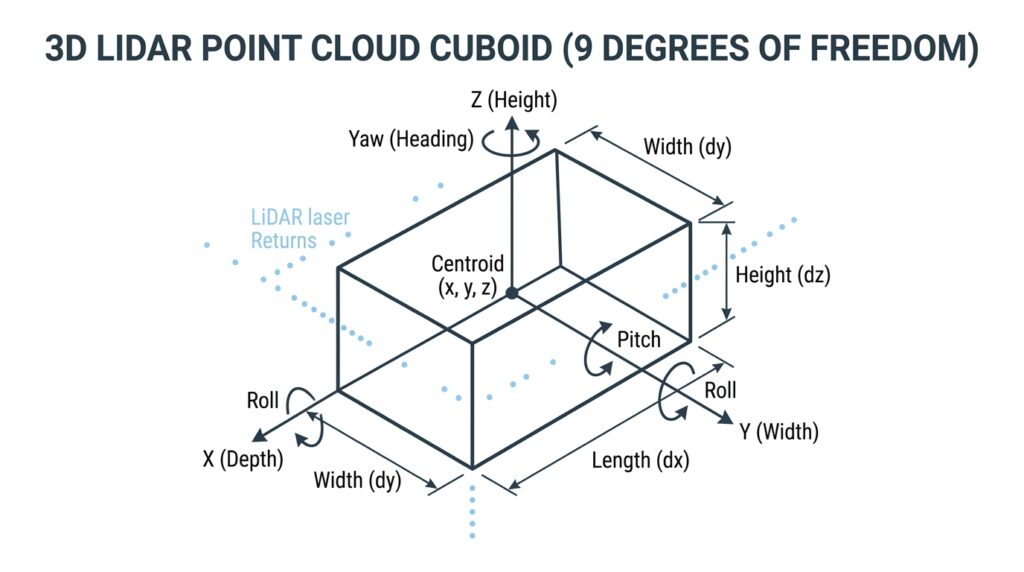
3D point cloud annotation is the process of labeling three-dimensional spatial returns captured by LiDAR, radar, and depth sensors. Operating in 3D metric space requires sophisticated camera projection and spatial manipulation tools:
- 9-Parameter Bounding Cuboids: Enclosing 3D point clusters with nine primary parameters: three spatial centroid coordinates(x,y,z), three physical dimensions (length, width, height), and three Euler rotation angles (yaw, pitch, roll).
- Intensity and Return-Echo Filtering: Visualizing laser return reflectivity to isolate lane markings, retro-reflective safety tape, and structural boundaries within sparse point clouds.
- Point-Level Semantic Segmentation: Classifying millions of individual laser returns by point categories (ground plane, drivable surface, curb, structural obstacle) to train volumetric neural networks.
Multi-Sensor Fusion & Calibration
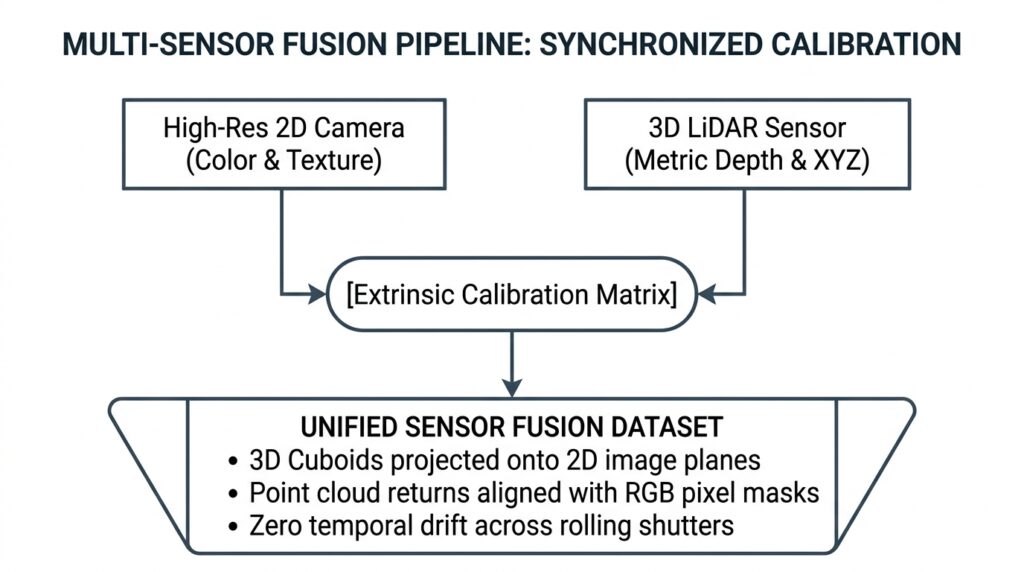
Sensor fusion annotation involves aligning and labeling data across multiple synchronized sensor streams, such as 2D RGB perspective cameras, 3D LiDAR sweeps, and radar velocities:
- Extrinsic and Intrinsic Matrix Calibration: Utilizing(K[R∣t]) camera calibration matrices to project 3D LiDAR cuboids directly onto 2D image planes, ensuring zero geometric parallax between sensor streams.
- Bird’s Eye View (BEV) Projection: Unifying multi-camera perspective streams into a top-down spatial grid, eliminating camera distortion across vehicle blind spots and overlapping fields of view.
- Radar Velocity Correlation: Synchronizing sparse radar micro-Doppler velocity vectors with visual bounding boxes for robust tracking in low-visibility environments.
Temporal Video Annotation & Multi-Object Tracking (MOT)
Temporal video tracking extends labeling across continuous frame sequences, capturing movement vectors, acceleration profiles, and state transitions:
- Persistent Instance IDs: Maintaining continuous object identity across thousands of video frames, even when subjects undergo temporary or prolonged occlusion behind static infrastructure.
- Spline Trajectory Interpolation: Automatically calculating smooth motion paths between verified keyframes, reducing manual keypoint entry while logging accurate heading vectors.
- Behavioral State Tagging: Annotating action boundaries (such as “forklift turning”, “operator reaching”, “hazard perimeter entered”) to train foundation models and Vision-Language-Action (VLA) architectures.
Hierarchical and Nested Classification
Hierarchical classification replaces flat, ambiguous label lists with recursive parent-child ontological trees:
- Multi-Tier Classification Trees: Tagging objects through recursive taxonomic layers (e.g. Equipment → Material Handling → Forklift → Counterbalanced High-Lift).
- Dynamic Conditional Attributes: Configuring workflow interfaces where secondary prompts trigger only based on primary selections (e.g. selecting Fastener == Bolt dynamically displays attributes for Thread Pitch, Grade Rating, and Surface Oxidation).
- Ontological Consistency: Eliminating labeler confusion by embedding strict visual reference guides directly within the annotation interface.
4. How AI-Assisted Pre-Labeling Improves Data Operations
High annotation throughput and ground-truth precision are not mutually exclusive when AI foundation models are integrated thoughtfully into the labeling loop.
Rather than relying on manual pixel tracing for every standard shape, modern dataset pipelines leverage foundation models, such as the Segment Anything Model (SAM), alongside automated bounding box trackers to generate initial candidate geometries:
- Prompt-Based Mask Generation: Annotators provide bounding box prompts or single-click points, allowing SAM to instantiate high-resolution segmentation masks instantly.
- Automated Keyframe Interpolation: For continuous video tracking, predictive tracking algorithms interpolate object paths across linear motion sequences between verified keyframes.
- Human-in-the-Loop Verification: AI pre-labeling never bypasses human validation. Human annotators inspect every generated boundary, correct edge artifacts, resolve boundary clipping, and assign nuanced taxonomic attributes.
By handling the mechanical burden of initial geometry drafting, AI assistance significantly reduces annotator cognitive fatigue. Annotator focus shifts entirely to where human judgment is irreplaceable: diagnosing complex edge cases, adjudicating ambiguous boundaries, and enforcing strict ground-truth fidelity.
5. How LabelOps Builds Closed-Loop Annotation QA Pipelines
How should annotation quality be audited in production machine learning?
Quality control cannot be an afterthought conducted via casual manual spot-checks. Reliable ground truth requires a closed-loop quality assurance pipeline integrated directly into the annotation operation:
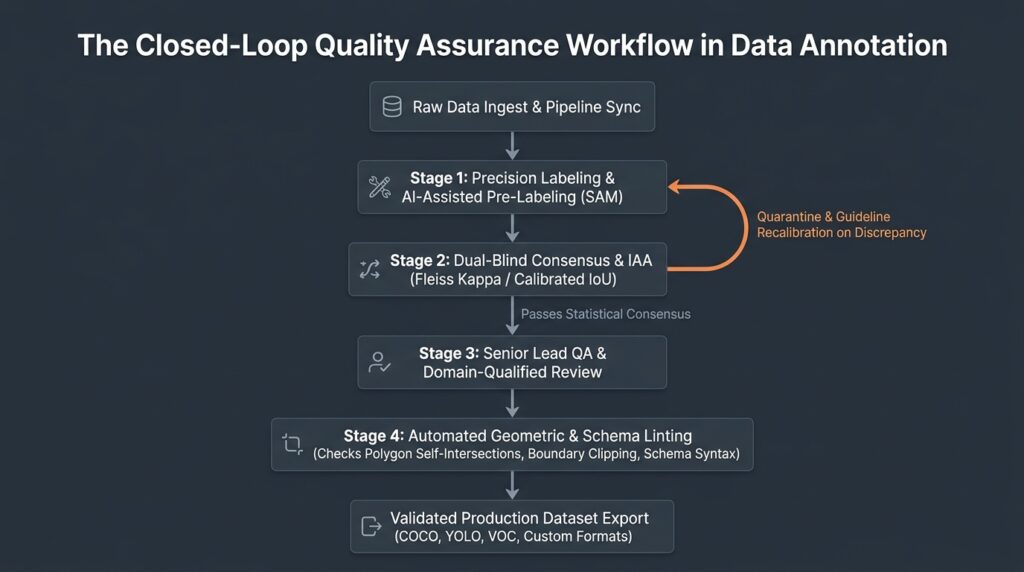
- Dual-Blind Calibration Sprints: When establishing a new dataset ontology, sample batches are labeled independently by multiple annotators without visibility into each other’s outputs. Discrepancies are surfaced automatically to measure Fleiss’ Kappa(κ) and align annotator interpretation before scaling production.
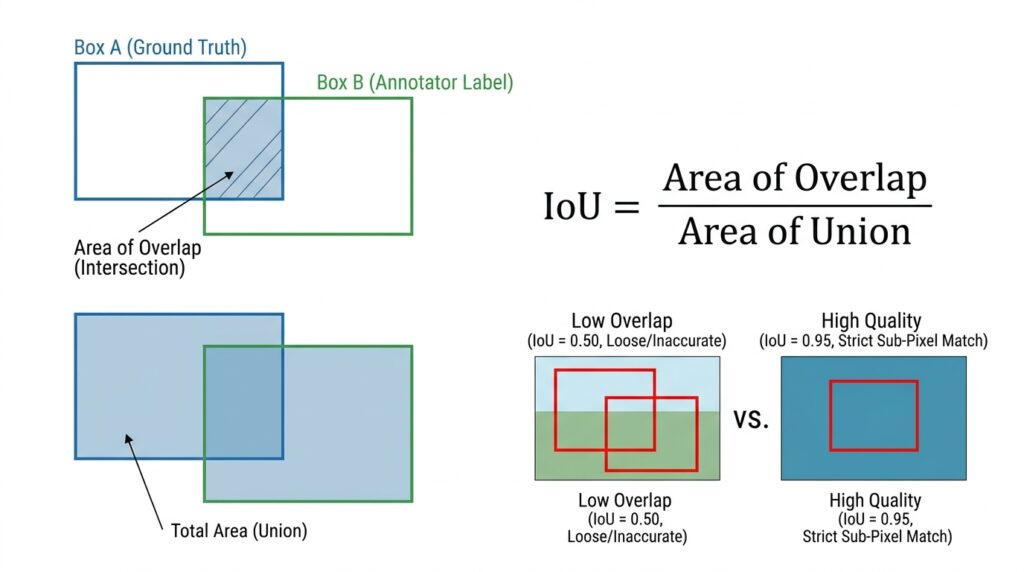
- Project-Calibrated Statistical Consensus (IoU): LabelOps applies project-calibrated Intersection-over-Union (IoU) acceptance thresholds based on annotation modality and downstream model requirements. For rigid 2D and 3D bounding geometries, projects often establish acceptance thresholds in the IoU≥0.90–0.95 range, while complex polygon segmentation tasks use tailored thresholds (such as IoU≥0.85–0.90) calibrated to boundary intricacy and model sensitivity.
IoU = (Area of OverlapArea of Union) ⁄ (Area of Overlap)
- Active Batch Quarantine: If an edge case triggers annotator variance beyond defined IoU or class ambiguity thresholds, the platform automatically quarantines the batch. A Quality Lead reviews the flagged samples, updates the central annotation manual, and propagates the corrected edge-case guidance across all annotator workstations.
- Automated Geometric & Schema Linting: Programmatic validation scripts run continuously before batch export. These automated checkers detect polygon self-intersections, bounding box clipping at image borders, duplicate instance IDs, and schema syntax mismatches.
- Domain-Qualified Escalation: Nuanced, high-stakes edge cases (such as micro-fractures in industrial components or subtle anatomical margins in medical imaging) are automatically routed to senior QA Leads and domain-qualified reviewers for final sign-off.
6. Why Frontier AI and Multimodal Systems Expand the Dataset Problem
- 3D Point Clouds and LiDAR: 3D cuboids and point-level segmentation for spatial perception and robotics.
- Multi-Sensor Fusion: Camera, LiDAR, and radar data aligned through calibrated coordinate transformations so that observations from different sensors correspond to the same physical environment
- Continuous Video: Multi-object tracking and temporal annotations that preserve how objects and events evolve across sequences rather than treating every frame independently.
- Text and Audio Grounding: Video paired with transcripts, audio events, timestamps, and visual-question-answering data for multimodal understanding.
- Medical Imaging: DICOM-based datasets requiring structured segmentation and volumetric annotations across different imaging planes.
7. How to Evaluate Enterprise Data Annotation Services for Production Computer Vision
For engineering teams evaluating external data annotation services, selecting a partner is not simply a matter of hourly cost per frame. In production computer vision, dataset quality is the outcome of the entire data operation: ontology design, workflow configuration, tooling precision, annotator expertise, QA rigor, and integration with the client’s ML pipeline.
When auditing enterprise data annotation services, ML engineering leads and technical directors should evaluate six core operational capabilities:
| 1. Bespoke Workflows | 2. CV Engineers & QA | 3. Enterprise Operations |
|
|
|
- Dedicated CV Engineers and QA Leads: Does the provider assign dedicated Computer Vision Engineers and QA Leads who collaborate peer-to-peer with your ML team, calibrate guidelines, write automated validation scripts, and resolve edge-case ambiguities?
- Modality Competence Beyond 2D Bounding Boxes: Can the annotation environment natively handle 3D LiDAR point clouds (9-parameter cuboids), sensor fusion extrinsic calibration matrices (K[R∣t]), temporal video tracking with persistent IDs, and multi-tier taxonomies?
- Multimodal and Spatial Competence: Does the provider support cross-modal dataset workflows spanning 3D LiDAR point clouds, sensor fusion calibration, temporal video tracking, and multimodal text and audio alignment for advanced AI architectures?
- Structured Variance & Edge-Case Curation: Does the operation actively assist in identifying and prioritizing informational variance across the statistical long tail, rather than simply processing uncurated volume?
- Verifiable Mathematical QA: Does the service provide verifiable statistical consensus reports (Fleiss’ Kappa, calibrated IoU distributions) and automated geometric linting rather than unverified marketing claims of 99% accuracy?
- Enterprise Data Governance & Privacy Controls (US & EU): Does the provider maintain GDPR-aware data handling for European projects and HIPAA-aligned workflows where protected healthcare data applies, alongside role-based access controls and encrypted cloud bucket syncing (AWS S3, Google Cloud Storage, Azure Blob)?
- Documented Data Retention & Secure Deletion: Does the contract define documented data retention and secure deletion procedures following project completion?
This is where LabelOps takes a differentiated approach. LabelOps is not a generic, off-the-shelf software tool, nor a commodity click farm. We operate as a dedicated data annotation and dataset engineering partner powered by proprietary internal tooling, pairing client machine learning teams directly with in-house Computer Vision Engineers to deliver validated, production-ready training datasets.
Optimize Your Training Data for Real-World Inference
Stop paying for redundant data annotation that yields diminishing returns. Equip your models with the precise variance they need to succeed in production.
LabelOps combines custom platform tooling, dedicated Computer Vision engineering, AI-assisted efficiency, and multi-stage consensus QA to deliver enterprise-grade training data for production computer vision and multimodal AI.
Whether you are building autonomous perception datasets, preparing multimodal training data, or scaling annotation operations for production computer vision, our engineering team can configure a tailored data operations pipeline around your model, ontology, and quality requirements.
Request a Data Annotation Project Consultation with LabelOps →
Frequently Asked Questions About Computer Vision Data Annotation
Why does model performance plateau during validation?
Performance plateaus occur when models are fed redundant, homogeneous data that provides minimal new information. Breakthroughs require curating complex edge cases and structured variance across the statistical long tail rather than expanding raw volume with baseline samples.
What is data annotation accuracy versus consistency?
Accuracy measures how closely a label matches true physical ground reality. Consistency measures whether identical visual features receive the exact same label and boundary definitions across different annotators and timeframes.
What is structured variance in computer vision datasets?
Structured variance is the deliberate, representative inclusion of training examples capturing meaningful operational differences in lighting, occlusion, scale, environmental noise, and physical morphology, maximizing informational return per annotated frame.
How does LabelOps support enterprise data security for US and European clients?
LabelOps applies GDPR-aware data handling protocols and HIPAA-aligned controls for sensitive feeds. We support direct VPC peering, encrypted cloud bucket transfers (AWS S3, GCS, Azure), role-based access controls, and documented data retention and secure deletion procedures upon project completion.
How do LabelOps CV Engineers and QA Leads support client machine learning teams?
LabelOps assigns dedicated Computer Vision Engineers and QA Leads to every engagement. They collaborate peer-to-peer with client teams to refine ontologies, build automated geometry validation scripts, and resolve edge-case ambiguities.
How does the Segment Anything Model (SAM) improve annotation efficiency?
SAM generates rapid initial segmentation masks from simple bounding box prompts or click points. Human annotators then inspect, correct, and validate the mask, reducing manual click fatigue while preserving ground-truth precision.
What is Inter-Annotator Agreement (IAA)?
Inter-Annotator Agreement is a statistical measure of consensus among multiple human annotators labeling identical data. It is quantified using metrics like Fleiss’ Kappa for classifications and Intersection-over-Union (IoU) for spatial geometries.
Does LabelOps sell its software as a self-serve SaaS product?
No. LabelOps operates as an advanced data annotation service powered by our proprietary platform. We provide dedicated dataset engineering and managed labeling operations, utilizing our internal tooling as the operational engine for client projects.
References
- Northcutt, C. G., Athalye, A., & Mueller, J. (2021). Pervasive Label Errors in Test Sets Neatly Destabilize Machine Learning Benchmarks. 35th Conference on Neural Information Processing Systems (NeurIPS 2021) Track on Datasets and Benchmarks.
- Kirillov, A., Mintun, E., Ravi, N., Mao, H., et al. (2023). Segment Anything. IEEE/CVF International Conference on Computer Vision (ICCV 2023).
- Fleiss, J. L. (1971). Measuring Nominal Scale Agreement Among Many Raters. Psychological Bulletin, 76(5), 378–382.
- Geiger, A., Lenz, P., Stiller, C., & Urtasun, R. (2013). Vision Meets Robotics: The KITTI Dataset. International Journal of Robotics Research (IJRR).