


An enterprise buyer’s guide to managed annotation workforces, AI data platforms, quality assurance, security, scalability, and production Computer Vision workflows.
Building production computer vision or enterprise AI requires more than a capable model architecture. The quality, consistency, and security of your training data directly determine how reliably that model performs outside the lab.
For enterprise AI teams, choosing a data annotation company is not simply about labeling the most images at the lowest cost. The decision affects model development timelines, engineering workload, data security posture, quality assurance overhead, and whether your pipeline can scale to production volumes.
Different providers operate in fundamentally different ways. Some provide annotation platforms for internal teams. Others provide managed annotation workforces. A smaller number combine data annotation with model development, system integration, and deployment.
This guide compares 10 leading data annotation and labeling companies relevant to enterprise AI in 2026, evaluated across annotation quality, workforce model, security and data handling, modality coverage, scalability, and workflow integration.
At a Glance: Which Provider Fits Your AI Data Workflow?
- Need a managed annotation workforce? LabelOps
- Need annotation plus CV engineering and deployment? Obraz
- Need large-scale AI data operations? Scale AI
- Need specialized 3D/LiDAR annotation? Label Your Data
- Need a multimodal annotation platform? SuperAnnotate
- Need domain-focused managed teams? iMerit
- Need an AI data infrastructure platform? Labelbox
- Need complex medical/video data workflows? Encord
- Need managed high-consistency annotation? Sama
- Need global multilingual data programs? Appen
Comparison at a Glance
| Company | Best Suited For | Operating Model | Key Strengths |
| LabelOps | Managed, high-volume annotation | Managed workforce | Scalable delivery, QA, image/video/audio/NLP |
| Obraz | Secure CV engineering + annotation | In-house | Data sovereignty, SegForge, full-lifecycle CV |
| Scale AI | Large-scale AI data programs | Platform + managed data | Data Engine, evaluation, 3D, GenAI |
| Label Your Data | Specialized 3D/LiDAR annotation | Managed services | 3D point clouds, tool-agnostic, security |
| SuperAnnotate | Multimodal annotation workflows | Platform + services | Pixel-perfect tooling, LLM fine-tuning, multimodal |
| iMerit | Domain-focused annotation | Managed teams | Healthcare, geospatial, compliance |
| Labelbox | AI data infrastructure | Platform | Workflow editors, evaluation, RL environments |
| Encord | Medical, video, 3D/LiDAR data | Platform | DICOM/NIfTI, video tracking, sensor fusion |
| Sama | Managed workforce annotation | Managed workforce | Consistent IAA, 3D, automotive/robotics |
| Appen | Global multilingual AI data | Distributed workforce | 80+ languages, speech, global scale |
What Should Enterprises Evaluate in a Data Annotation Company?
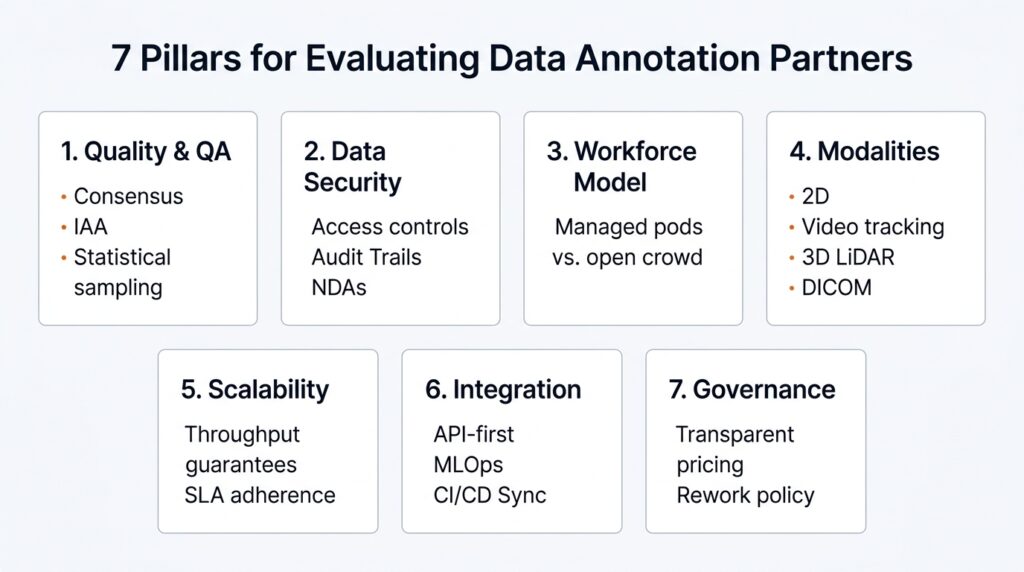
Before comparing individual vendors, establish your baseline requirements.
Annotation Quality and QA
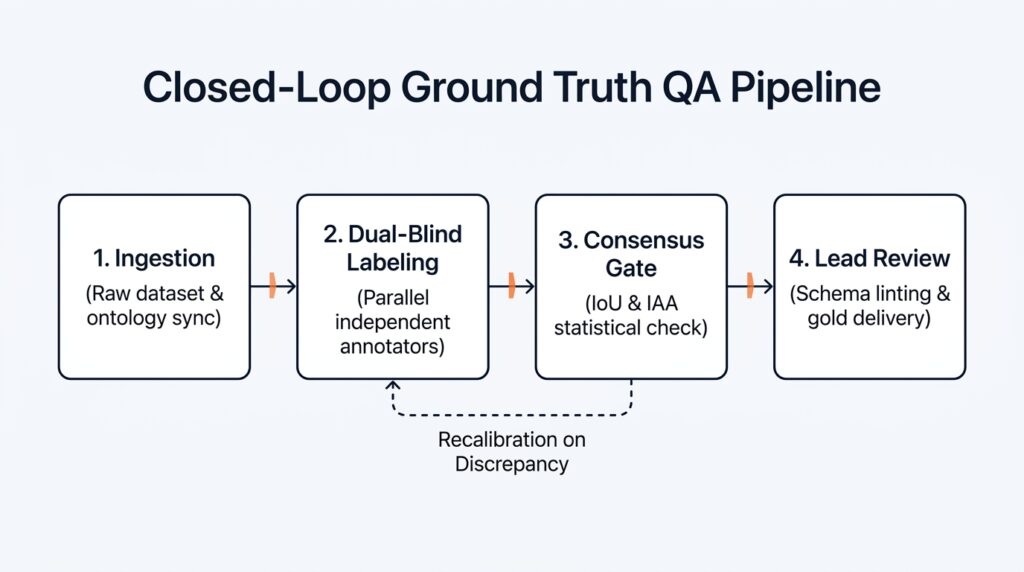
Look beyond headline accuracy numbers. Evaluate how the provider handles inter-annotator agreement, ambiguous classes, edge cases, occlusion, multi-stage review, automated quality checks, and rework processes. For production computer vision, the quality of a small set of difficult examples often matters more than volume.
Security and Data Handling
Enterprise datasets can contain proprietary products, manufacturing environments, medical images, or defense-related information. Evaluate access controls, workforce model, workstation and network controls, data transfer and storage, retention and deletion policies, third-party dependencies, and applicable certifications.
Workforce Model and Domain Expertise
The gig-economy crowdsourcing model can create challenges for enterprise AI. Complex tasks such as sensor fusion or DICOM annotation may require specialized training, domain expertise, and consistent quality controls rather than a broadly distributed workforce. Common models include open crowdsourcing, managed teams, dedicated project pods, and specialist annotators.
Annotation Modalities
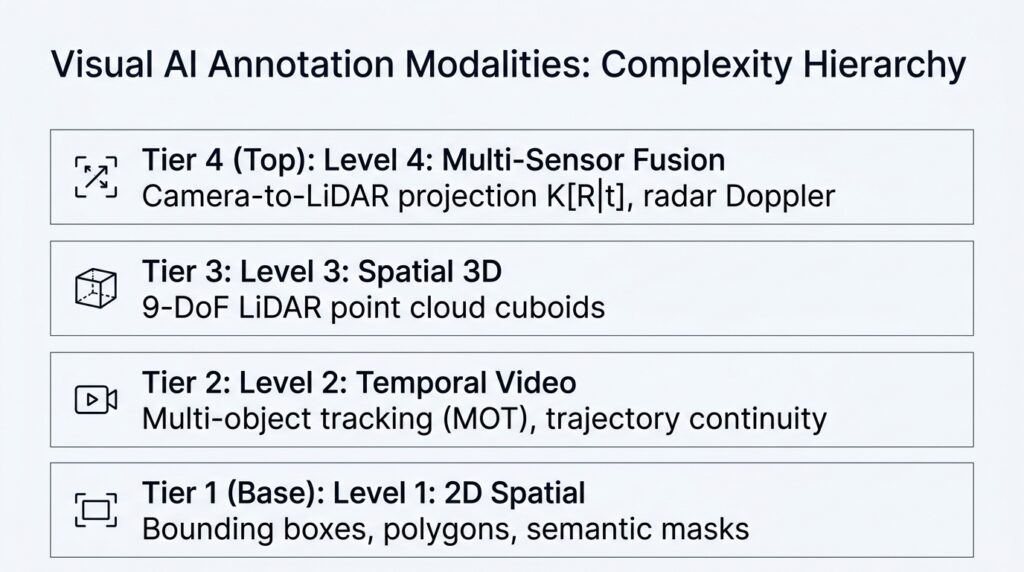
Your partner must support the data topologies your models consume: computer vision data annotation for 2D/3D bounding boxes and polygon segmentation, temporal video annotation for multi-object tracking, 3D point clouds and LiDAR cuboids, NLP and audio, and medical formats like DICOM and NIfTI. Output schemas (COCO, Pascal VOC, KITTI, ROSBAG) and integration requirements should be evaluated before a project begins.
Scalability and Throughput
A vendor that performs well on a pilot may not perform the same way at production scale. Evaluate workforce scaling, quality at higher volumes, SLA management, rework processes, dataset versioning, and handling of changing ontologies.
Platform and Workflow Integration
The annotation environment should integrate into your ML lifecycle. Look for API-first architectures, model-assisted labeling, active learning loops, cloud storage integration, and seamless connection between annotation and training production AI models.
Pricing and Engagement Models
Move beyond per-image pricing. Evaluate FTE dedicated pods, tiered-volume structures, and outcome-based pricing that includes QA and rework. Understand how edge-case handling, ontology updates, and rush requirements affect the final cost.
Top 10 Data Annotation & Labeling Companies in 2026
1. LabelOps
Best for: Managed, high-volume data annotation and dedicated annotation workforces.
LabelOps is built for enterprises that have strong internal ML engineering teams but need a scalable, managed annotation workforce to fuel their data pipelines. It operates on dedicated hourly and tiered-volume structures (scaling to 55,000+ hours), providing guaranteed throughput for large spatial datasets and high-velocity video streams. LabelOps currently reports more than 2,000 annotators, more than 2 billion labels delivered, and 99.87% accuracy.
Managed Workforce: A managed, employee-level workforce with strict performance metrics, ensuring high IAA scores and consistent taxonomy application across projects.
Capabilities: Comprehensive support across image, video, audio, and NLP, with deep expertise in complex video annotation services and multi-frame tracking.
Quality Assurance: Built-in, multi-tier QA layers and direct communication channels between your ML engineers and annotation pod leads.
Enterprise Use Cases: High-volume retail analytics, large-scale spatial computing datasets, and continuous active-learning loops for production CV models.
Why It May Fit: A strong fit for enterprises that need a dedicated, scalable external workforce integrating into their existing MLOps infrastructure without sacrificing quality.
What to consider: Designed for enterprises that need a managed external workforce. Organizations requiring full end-to-end CV engineering and deployment should also evaluate Obraz.
2. Obraz
Best for: Secure, in-house annotation and integrated Computer Vision engineering.
Obraz approaches computer vision as full-stack software engineering. While most AI data annotation companies treat labeling as an isolated task, Obraz connects annotation to the entire Computer Vision lifecycle: use-case definition, data annotation, dataset engineering, model development, validation, optimization, and deployment.
Obraz uses SegForge, its proprietary annotation platform, as part of its controlled in-house data annotation infrastructure. SegForge is engineered for zero-trust security, air-gapped workflows, and cryptographic audit logs.
Engineering-Grade Ground Truth: Annotation teams work directly alongside CV engineers and domain experts. The data is annotated with a precise understanding of the model’s architectural requirements and edge-case vulnerabilities.
End-to-End Integration: From secure data ingestion to custom SaaS integration and edge deployment, Obraz handles the entire lifecycle.
Enterprise Use Cases: Highly sensitive defense imagery, proprietary manufacturing defect detection, and secure medical AI pipelines.
Why It May Fit: If your project involves highly classified or proprietary data and you need a partner to engineer the entire pipeline (from secure ground truth to a deployed system), Obraz eliminates vendor fragmentation and security risks.
What to consider: Obraz’s integrated engineering model is designed for projects that require more than annotation alone. Teams that only need a managed annotation workforce should evaluate LabelOps directly.
3. Scale AI
Best for: Large-scale AI data and enterprise AI programs.
Scale AI is one of the largest players in the AI data space, known for solving the data bottleneck for foundational models and autonomous systems. Their Data Engine combines automation with human expertise to curate training data for massive enterprise AI programs.
Capabilities: Large-scale data processing, RLHF for LLMs, 3D sensor fusion, and complex autonomous vehicle data annotation.
Enterprise AI: Enterprise-grade SLAs, dedicated customer operations, and advanced model evaluation tooling.
Why It May Fit: Relevant for well-funded enterprises and AV companies needing to process petabytes of raw sensor data and build foundational models.
What to consider: Designed for large-scale enterprise programs. Teams with smaller or highly specialized CV projects may find the commercial model better suited to high-volume engagements.
4. Label Your Data
Best for: Enterprise data labeling and specialized annotation workflows.
Label Your Data operates as a highly secure, tool-agnostic data-labeling partner. They provide human-powered annotation services for organizations that need to create complex datasets without being locked into a specific software ecosystem.
Capabilities: Strong focus on LiDAR, 3D cuboids, skeletal keypoint annotation, and 3D point cloud annotation.
Security: Enterprise-grade security protocols and a managed workforce model that avoids public crowdsourcing.
Why It May Fit: A strong fit for robotics and spatial computing teams that require specialized 3D annotation but prefer to manage their own ML models internally.
What to consider: Operates as a data labeling service partner rather than providing full software system integration or CV engineering.
5. SuperAnnotate
Best for: Multimodal AI data infrastructure and annotation workflows.
SuperAnnotate has evolved into a comprehensive multimodal data orchestration platform. They support image, video, text, and audio, with a strong emphasis on agentic AI and human-in-the-loop workflows.
Capabilities: Advanced UI tooling for pixel-perfect segmentation, LLM fine-tuning data, and multimodal dataset management.
Why It May Fit: Well suited for enterprises building multimodal foundation models or agentic AI systems that require complex data orchestration and have the internal workforce to execute the labeling.
What to consider: Primarily a software platform. While managed labeling marketplace options exist, the core strength is the annotation tooling itself.
6. iMerit
Best for: Specialized enterprise annotation and domain-focused AI data.
iMerit provides managed data annotation services through specialized, full-time teams. They focus heavily on building domain-specific pods for industries like healthcare, agriculture, and autonomous systems.
Capabilities: Strong compliance frameworks (HITRUST, ISO 27001, SOC 2), geospatial data annotation, and medical image annotation support.
Why It May Fit: Suitable for enterprises that require dedicated, domain-focused teams for ongoing production workflows, particularly in regulated industries.
What to consider: Better suited for large ongoing operational programs rather than rapid prototyping or short-term engagements.
7. Labelbox
Best for: AI data infrastructure and internal AI teams.
Labelbox has transitioned from a pure training data platform into a comprehensive AI data infrastructure provider. Their current focus includes AI agent evaluation, reinforcement learning (RL) environments, and human preference data.
Capabilities: Node-based workflow editors, LLM-as-a-judge evaluations, and programmatic quality assurance.
Why It May Fit: Ideal for internal AI teams building agentic workflows or RL environments who need a platform to manage their own data pipelines and evaluation metrics.
What to consider: As a platform, you must still manage the integration of your own workforce or BPO partners for the actual annotation operation.
8. Encord
Best for: Multimodal, medical, video, and 3D/LiDAR data workflows.
Encord is a highly specialized platform utilizing advanced micro-models and multi-stage QA for complex visual data. They excel in temporal tracking and multi-sensor environments.
Capabilities: Native support for DICOM/NIfTI medical image annotation, complex video tracking, and sensor fusion workflows.
Why It May Fit: Particularly relevant for healthcare AI and autonomous systems teams dealing with heavy video and 3D/LiDAR datasets who need advanced data curation and active learning tooling.
What to consider: Focused on tooling and data evaluation. Custom quote-based pricing requires direct engagement to scope.
9. Sama
Best for: Managed annotation with a full-time workforce.
Sama’s primary differentiator is its dedicated, full-time workforce, which produces highly consistent IAA scores. They are heavily utilized for high-volume image, video, and 3D workflows.
Capabilities: 3D point-cloud annotation, sensor fusion, and multi-frame object labeling.
Why It May Fit: A strong fit for enterprises looking to outsource annotation to a managed workforce rather than relying on crowdsourcing, particularly for automotive and robotics applications.
What to consider: The full-time employee model may carry higher per-unit costs compared to crowdsourced alternatives.
10. Appen
Best for: Global-scale and multilingual AI data programs.
Appen is one of the oldest players in the AI data space, utilizing a large global workforce to handle text, speech, and image annotation services across 80+ languages.
Capabilities: Multilingual NLP, global data collection, and red-teaming for LLMs.
Why It May Fit: Relevant for global enterprises needing geographically diverse data collection and multilingual localization.
What to consider: The distributed crowdsourcing workforce model can introduce quality variance for highly complex or proprietary computer vision tasks that require strict domain expertise.
How to Choose: Platform vs. Managed Workforce vs. Engineering Partner
When evaluating data annotation companies, the first decision should not be “which company is number one.” It should be: what operating model does your AI program require?
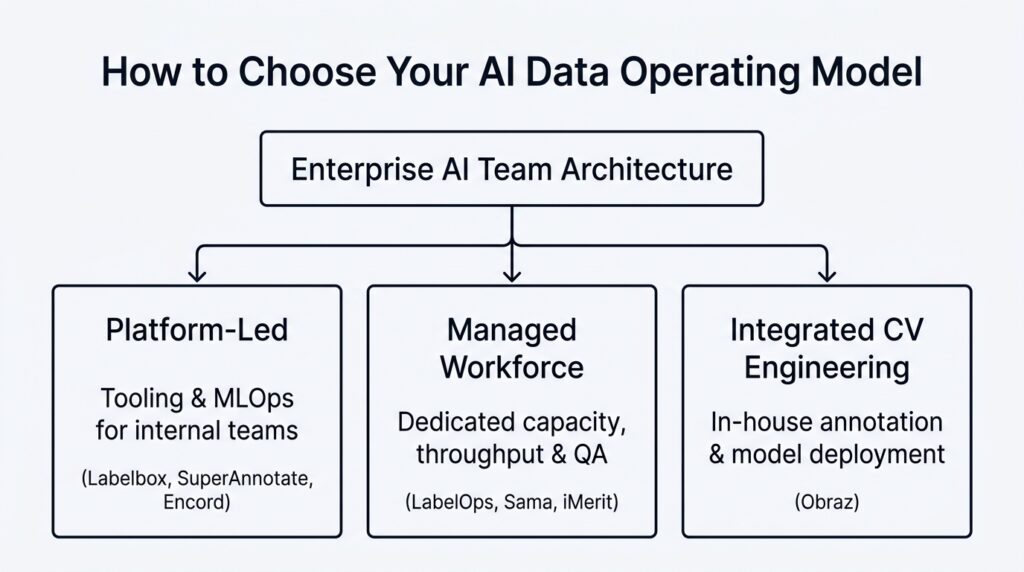
Choose a platform if your internal team has the people and processes to manage annotation but needs software for dataset management, quality control, workflow automation, and model-assisted labeling. Labelbox, SuperAnnotate, and Encord serve this model.
Choose a managed annotation workforce if your ML team has engineering capability but does not want to build and manage a large annotation operation internally. LabelOps, Sama, and iMerit serve this model.
Choose an integrated engineering partner if annotation is only one component of the system you are building and the project requires data annotation, dataset engineering, model development, validation, software integration, and deployment to work together. Obraz serves this model.
If you need high-volume, linguistically diverse data collection across global markets, Appen and similar distributed-workforce providers cover that segment.
Planning an Enterprise Data Annotation Project?
The right annotation partner depends on your dataset, annotation requirements, quality targets, security constraints, expected volume, and ML workflow.
LabelOps can help scope the annotation workforce, workflow, quality process, and delivery model required for your project. Whether you are building ADAS training data pipelines, 3D point cloud datasets for robotics, or secure DICOM annotation for healthcare AI, start with the operational requirements of your model.
Share your dataset type, annotation requirements, expected volume, and QA targets with the LabelOps team.
Explore LabelOps Data Annotation Services
Discuss Your Annotation Requirements
Frequently Asked Questions
What is a data annotation company?
A data annotation company provides the people, processes, and/or software required to label datasets used to train and evaluate machine learning and AI systems. Depending on the provider, services can include image, video, text, audio, LiDAR, 3D point-cloud, and other specialized annotation workflows. Enterprise-grade providers typically add managed workforces, multi-tier quality assurance, data security protocols, and integration with production ML pipelines.
What is the difference between a managed annotation workforce and crowdsourced annotation?
Managed annotation workforces employ dedicated, full-time annotators who are trained on your specific ontology and maintain consistent IAA scores across large datasets. Crowdsourced annotation distributes tasks across a broad pool of on-demand workers. Managed teams are generally better suited for enterprise projects where data security, domain expertise, and annotation consistency are critical requirements. The appropriate model depends on the dataset, risk profile, complexity, and operational requirements.
How do I choose the right data annotation partner for enterprise AI?
Evaluate partners across seven dimensions: annotation quality and QA processes, security and data handling, workforce model (managed vs. crowdsourced), supported annotation modalities, scalability and throughput guarantees, platform and workflow integration capabilities, and pricing transparency. The right choice depends on whether you need a dedicated external workforce, a self-serve platform, or a full-stack engineering partner that handles annotation through deployment.
What data modalities should an enterprise annotation partner support?
Production AI projects typically require support for 2D image annotation (bounding boxes, polygons, semantic segmentation), video annotation with temporal tracking, 3D point cloud and LiDAR cuboid annotation, text and NLP labeling, audio transcription and alignment, and medical-specific formats like DICOM and NIfTI. Your partner’s tooling must natively support the output schemas your training pipeline consumes (COCO, Pascal VOC, KITTI, ROSBAG, and others).
Why is data security important when choosing an annotation company?
Enterprise AI projects often involve proprietary manufacturing data, classified defense imagery, or patient health information. Sending this data to broadly distributed annotation platforms introduces data sovereignty risks, compliance exposure, and potential IP leakage. Secure annotation partners enforce controlled workstation access, workforce screening, network restrictions, documented data-handling policies, and compliance with applicable frameworks such as HIPAA, GDPR, ISO 27001, and SOC 2.
What is the difference between LabelOps and Obraz?
LabelOps focuses on managed data annotation operations and annotation workforces. Obraz combines controlled in-house annotation (through LabelOps) with Computer Vision engineering, dataset development, model development, software integration, and deployment. The two serve different enterprise operating models: LabelOps for teams that need a scalable annotation workforce alongside their own engineering, Obraz for teams that need the data and engineering layers to work together end to end.