

Designing high-performance computer vision models needs more than crowdsourced tagging and generic bounding boxes. As AI moves from experimental proof-of-concept projects to mission-critical production systems, data quality will directly determine safety, model accuracy, and deployment speed.
CTOs, enterprise engineering teams, CIOs, and heads of AI/ML face severe headwinds when training data pipelines fail to scale securely and accurately. This guide breaks down the architectural, core technical, and operational criteria for selecting an enterprise data annotation vendor.
Key Takeaways
• Precision Engineering Over Crowd Volume: High-performing production models need domain-expert annotators, rigorous consensus protocols, and automated validation.
• Data Security Is Non-Negotiable: SOC 2 Type II compliance, HIPAA readiness, ISO 27001 certifications, and zero-data-retention pipelines secure proprietary IP.
• Hybrid Infrastructure Capabilities: Seamless integration via GraphQL/REST APIs, Python SDKs, and cloud-native storage connectors accelerates iteration loops.
• Scalability Demands Domain Expertise: Complex modalities like 3D point clouds, LiDAR sensor fusion, and multi-spectral video demand specialized annotation workflows.
• End-to-End Strategic Value: Partnering with a comprehensive technical partner like LabelOps closes the gap between raw data labeling and production deployment.
The enterprise AI model features an advanced architecture, optimized inference pipelines, and robust GPUs, but still struggles in production. Most importantly, in many cases, the underlying issue begins long before model training – incomplete datasets, inconsistent labels, weak quality controls, etc.
For engineering leaders, heads of AI/ML, CIOs and CTOs, selecting a data annotation service might need more than price comparison or labelled image counts. The right partner should understand your models’ technical requirements, secure sensitive datasets, maintain consistent ground truth, and support the transition from experimentation to production.
Understanding how to choose a data annotation service provider therefore requires a structured evaluation of annotation expertise, quality assurance, security, operational scalability, and engineering compatibility.
Additionally, enterprises need to distinguish among vendors who execute annotation tasks and those partners contributing to dependable AI data pipelines.
Data Annotation Quality Assurance: Audit The Procedure, Not Percentages
Each vendor will quote an accuracy figure. Just ask how the vendor measures it. Data annotation quality assurance must be a procedure that can be audited, not simply a number on the sales slide. Test these five things –
• IAA (Inter-Annotator Agreement)
Inquiry for Fleiss’ Kappa on class labels and IoU-based agreement on boxes and masks. Insist on per-class reporting, as a dataset-wide average will hide weak classes.
• Multi-Stage Review
Check out for blind consensus, independent dual annotation, and a lead QA pass. When the second reviewer views the first reviewer’s label, the confirmation bias creeps in.
• Programmatic Checks Before Human Reviews
Scripts need to reject boxes outside the image bounds, broken class hierarchies, and track IDs changing between frames.
• Edge-Case Handling
Motion blur, occlusion, and ambiguous classes drive most production failures. Inquire with the vendor on how they document such cases, escalate them, and feed them back into your ontology.
• Rework Terms
Vendors need to fix rejected labels at no extra cost. Also, they have to report the root cause of each miss.
In computer vision data annotation, a tiny set of hard examples with right labels often lifts the model more than a large pile of easy ones. Your vendor must treat hard cases as the priority, not as an exception.
Also run a blind pilot, where you hold back a gold set of expert-labeled items from your own data. Now, have each of the shortlisted vendors label it blindly and score the output against your reference. This single test will outweigh any brochure.
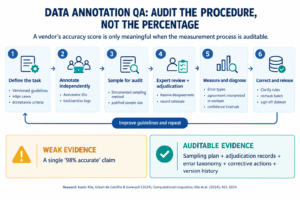
Figure 1: Data Annotation QA Showing Vendor’s Accuracy Score Issue As Per The Study Done In On Efficient and Statistical Quality Estimation for Data Annotation.
A vendor’s “98% annotation accuracy” claim is not a quality assurance strategy.
Enterprise AI teams need to know how that number was measured, which samples were reviewed, how disagreements were resolved, and what happened when errors were discovered.
Multiple research works and studies reinforce an important point: annotation quality requires a defensible measurement process, not just an impressive percentage. Before approving an annotation partner, audit the procedure:
● Sampling methodology
● Expert review and adjudication
● Error analysis and corrective action
● Version control and audit trails
Don’t just buy an accuracy figure. Demand evidence of a repeatable quality process.
Secure Data Annotation – Treating Training Data Like Source Code
Commonly, training data will often carry proprietary products, patient scans, factory floors, and defence imagery. Secure data annotation begins with a single question: who touches your raw data, and what machine?
These seven controls must be evaluated –
• Access Control: Role-based access, least privilege, and per-project data isolation.
• Workstation & Network Limits: No local downloads, locked-down devices, and restricted network paths.
• Audit Trail: Logs that show who viewed or changed each item.
• Data Lifecycle: Encryption in transit and at rest, retention limits, and proof of deletion at project close.
• Compliance: Certifications such as ISO 27001 and SOC 2, plus alignment with HIPAA or GDPR where your data requires it.
• Third-Party Chain: Every subcontractor and tool vendor that touches your data.
• Workforce Screening: Employed, vetted annotators under NDA, not anonymous crowd workers.
Most importantly, ask the vendor to walk your security team through a live project environment, not policy PDFs.
Workforce Model: Data Annotation Outsourcing Works When You Control The Variables
Data annotation outsourcing moves labour outside your walls, so you need to see how that labour runs. Compare the common models:
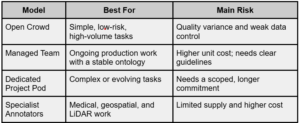
Complex tasks such as sensor fusion or DICOM labelling need trained annotators who stay on your project. A data labelling company that rotates anonymous workers across clients cannot hold a consistent taxonomy. Always ask about annotator tenure, training time per ontology, and whether CV engineers and QA leads work directly with your team.
Scalability, API Integrations, and MLOps Readiness
Manual batch exports via zip files create friction in modern CI/CD machine learning pipelines. When assessing how to choose a data annotation service provider, evaluate how well their architecture integrates with your existing MLOps ecosystem.
A modern enterprise data annotation partner should offer:
● Robust REST and GraphQL APIs
Enable automated pipeline triggers, job creation, and batch status querying.
● Native Python SDKs
Allow ML engineers to programmatically pull annotated datasets directly into PyTorch, TensorFlow, or custom training loops.
● Active Learning & Auto-Labeling Integration
Leverage model-assisted pre-labeling (such as SAM or custom model weights) to speed up annotation velocity by 3x–5x.
● Elastic Workforce Scaling
Rapidly scale workforce capacity up or down to manage sudden dataset spikes without sacrificing accuracy.
Cost Transparency and Total Cost of Ownership (TCO)
Price per annotation often masks the true cost of training data operations. Low unit prices frequently translate into higher engineering overhead when internal teams waste hundreds of hours fixing poor labelling output.
When evaluating data annotation outsourcing options, compute the Total Cost of Ownership (TCO):
Total Cost = Vendor Service Cost + Internal QA Remediation Overhead + Model Retraining Penalties from Mislabeling
Selecting a dedicated data annotation partner that provides high-accuracy output on the first pass significantly reduces internal engineering overhead and accelerates time-to-market.
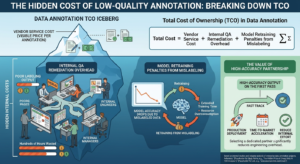
Figure 2: Hidden Cost of Low-Quality Annotation As Per The Study Done Related To The Hidden TCO of Sub-Standard Market Data Feeds
A Vendor Scorecard For CTOs And Procurement Teams
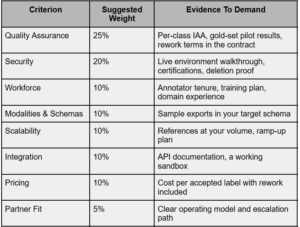
Use this scorecard to bring structure to enterprise data annotation vendor selection, and to decide how to choose a data annotation service provider when two finalists look equal.
Score each finalist from 1 to 5 on every criterion, multiply by the weight, and compare totals. Adjust the weights to your risk profile; regulated industries usually raise the security weight.
Five questions that expose a weak data labelling company fast:
● Who exactly labels my data, and where do they sit?
● What happens when two annotators disagree, and who decides?
● Can you show agreement scores per class from a past project?
● How do you handle a taxonomy change at 60% completion?
● What data leaves your environment, when do you delete my data, and how do you prove it?
How LabelOps Powers Enterprise Computer Vision Deployments
As a leading data labeling company, LabelOps serves as an end-to-end computer vision development and training-data partner for industry leaders across autonomous vehicles, aerial mapping, healthcare, logistics, and retail tech.
⬥Specialized Human-in-the-Loop Expertise
LabelOps pairs deep domain-expert annotators with advanced ML-assisted tools to deliver industry-leading accuracy. Whether segmenting complex medical imagery or tracking multi-camera autonomous vehicle sequences, LabelOps guarantees enterprise-grade precision.
⬥Bank-Grade Infrastructure & Secure Workflows
LabelOps provides robust, secure data annotation infrastructure supporting VPC deployments, SOC 2 compliance standards, strict RBAC controls, and zero-data-retention guarantees. Enterprise technology teams maintain complete control over their proprietary datasets throughout the entire annotation life cycle.
⬥Bridging the Sim2Real Gap
Beyond traditional annotation, LabelOps excels at synthetic data validation and aligning with real-world ground truth. By combining advanced statistical diagnostics, sensor-level validation, and iterative human review loops, LabelOps enables engineering teams to turn synthetic generation into a predictable, high-performing deployment pipeline.
Planning an enterprise annotation project?
The right partner depends on your dataset, annotation requirements, quality targets, security constraints, expected volume, and ML workflow.
Share your dataset type, modalities, volume, and QA targets with the LabelOps team and get a scoped plan for its data annotation services, including workforce, workflow, and delivery model. If you still weigh how to choose a data annotation service provider, bring your gold set and start with a pilot.
Discuss your annotation requirements. Contact Us
Frequently Asked Questions
► What is a data annotation partner?
A data annotation partner supplies the people, processes, and often the software that label data for training and evaluating machine learning models. A strong partner adds managed workforces, multi-stage QA, security controls, and integration with your ML pipeline.
►How to choose a data annotation service provider?
Score vendors on quality assurance, security, workforce model, modality coverage, scalability, integration, and pricing. Match the operating model to your team, then run a blind pilot against your own gold set before you commit.
►What is the difference between a managed workforce and crowdsourcing?
A managed workforce employs dedicated annotators who learn your ontology, which keeps agreement scores steady across large datasets. Crowdsourcing spreads tasks across an on-demand pool. Managed teams fit complex or sensitive work; crowds fit simple, low-risk tasks.
►What should data annotation quality assurance include?
Expect per-class agreement metrics, independent dual review, programmatic schema checks, documented edge-case handling, and rework at no extra cost.
►Is data annotation outsourcing safe for regulated data?
It can be, when the vendor proves its controls. Verify access restrictions, workforce screening, encryption, retention and deletion policies, and certifications that match your regulatory scope.