


Speed of the annotation pipeline determines how quickly sponsorship valuation and advertising intelligence work.
Sports never respect your reporting calendar. Fixtures cluster between Friday night and Sunday evening, yet sponsors, agencies, and rights holders expect exposure and media value reports the moment the business week opens. That mismatch creates the Monday morning SLA crisis, decided by one operational variable: data annotation turnaround time.
If your pipeline cannot turn Saturday’s footage into validated datasets by Monday, no analytics layer can rescue the report. This guide explains why weekends break annotation operations, why generalist vendors fail under pressure, and how time zone arbitrage and LabelOps combine to deliver a dependable sports data SLA for sponsorship valuation and advertising intelligence.
Key Takeaways
● Weekend volume spikes are a staffing-model issue, not a talent problem.
● Generalist BPOs structurally cannot staff Sunday nights.
● Time zone arbitrage turns your weekend into someone else’s business day and keeps annotation TAT inside 12 to 24 hours.
● LabelOps, not headcount alone, keeps an SLA intact at 3x peak volume.
● Sponsorship valuation is the most deadline-sensitive use case in sports data, because brands judge ROI on Monday.
The Weekend Is Where Sponsorship Value Is Made (and Measured)
Peak sponsor exposure happens on weekends. Logos on kits, LED boards, broadcast overlays and virtual ads all earn their screen time between Friday and Sunday. Brands, agencies and rights holders then expect exposure and media value reports at the start of the week. A late dataset means a late valuation, a delayed renewal conversation and a weaker negotiating position.
This makes data annotation turnaround time a revenue metric, not just an operations metric. So, every hour between the final whistle and a validated dataset is an hour your analysts and your clients spend waiting.
The Two-Clock Problem
Two clocks govern every sports data engagement:
● Clock 1-The Match Schedule: Weekend-heavy and unpredictable, with extra time, rescheduled fixtures, and doubleheaders.
● Clock 2- Client Reporting: Fixed to Monday 9 AM, regardless of what happened on the pitch.
The gap between those two clocks is where every Monday morning SLA dies.
Why the Weekend Breaks Annotation Operations
Friday-night fixtures through Sunday whistles produce the majority of your weekly ingestion volume. Weekend annotation volume does not just rise; it arrives in bursts, in parallel, and without warning. Teams sized for the Tuesday average are overwhelmed by Saturday afternoon.
Anatomy Of A Weekend Surge
Multi-league overlap, multi-camera feeds, and sudden bulk uploads after fixtures end combine into a wall of frames. Three leagues kicking off within the same two-hour window can triple queue depth before the first batch is even triaged.
Why Forecasting Alone Fails
Match duration, broadcast variations and late feed delivery make volume non-linear. A forecast built on fixture counts will miss the extra-time thriller, the weather delay and the feed that arrives six hours late. Forecasts must be paired with elastic capacity.
The Compounding Effect
A 4-hour delay on Saturday cascades into QA backlogs by Sunday night, which become rework on Monday. Weekend data annotation rarely fails in one dramatic moment. It fails through accumulation.
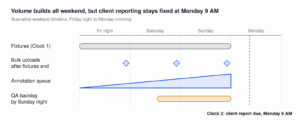
Figure 1: Weekend Annotation Volume Timeline
Fixtures build the queue from Friday night, a Saturday delay compounds into a QA backlog by Sunday night, and the Monday 9 AM deadline never moves.
The Hidden Cost of a Missed Monday
A single missed deadline carries four distinct costs:
● Revenue Risk: Delayed sponsor reports weaken renewals and upsells.
● Data Risk: Rushed annotation produces inconsistent logo labels, which means unreliable exposure metrics.
● Reputation Risk: A bad Monday report is remembered longer than ten good ones.
● Operational Risk: Analysts spend Monday firefighting instead of analyzing.
When you add these up, the cost of one missed Monday morning SLA often exceeds the cost of building a weekend-proof pipeline in the first place.
Why Generalist BPOs Fail Exactly When You Need Them
Crowdsourced gig workforces have no scheduled capacity. When a Saturday data dump lands, a generalist vendor either pays surge rates, queues your work behind three other clients, or quietly rubber-stamps frames to hit quota. You discover which one on Tuesday, from an angry account manager.
No Sport-Aware Workforce
Annotators who cannot tell a sponsor board from a broadcaster bug produce misclassified exposures, and misclassified exposures corrupt every downstream valuation.
Queue Contention
Your work competes with other clients’ priorities. A vendor with no dedicated sports pod cannot guarantee a sports data SLA, because the SLA belongs to whichever client shouts loudest.
No Visible Quality Controls
There is no inter-annotator agreement (IAA) reporting, no adjudication layer, and no audit trail. If the vendor cannot show its quality controls, you are trusting rather than verifying.
Time Zone Arbitrage: Your Weekend Becomes Our Business Day
Operating on IST (UTC+5:30) means our night shift runs while US and European teams sleep. Saturday and Sunday fixture data is annotated, QA-cascaded, and formatted overnight, so validated datasets land in your pipeline before your clients log in.
The Follow-The-Sun Handoff
Kickoff on Saturday is followed by ingest, annotation, multi-pass QA, and delivery well before Monday 6 AM local time. Nobody works a graveyard shift reluctantly; for our team, it is simply the working day.
12 To 24-Hour TAT As Architecture, Not Aspiration
A 12- to 24-hour annotation TAT is not a promise. It is a staffing model. Because capacity is scheduled around your fixture calendar, data annotation turnaround time becomes predictable instead of heroic.
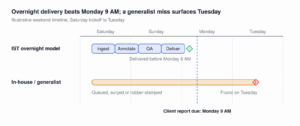
Figure 2: Delivery Timelines – IST Overnight Model VS Generalist
The IST overnight model delivers before Monday 6 AM local time, while a generalist vendor’s miss is typically discovered on Tuesday.
LabelOps: The Operating System Behind Weekend-Proof Annotation
What LabelOps Actually Means For Sports Data
LabelOps disciplines the procedure of running workforce planning, queue orchestration, tooling, guideline governance, and QA analytics as one integrated operation. It treats annotation as a production line with instrumentation, not as a pool of freelancers with a deadline.
How LabelOps Protects Weekend Annotation Volume
● Capacity Forecasting By League And Fixture Calendar: Headcount is scheduled before the fixtures happen.
● Dynamic Queue Routing: Priority tiers for sponsor-critical matches, with automatic load balancing across teams.
● Elastic Pods: Pre-trained bench annotators activated for derby days, finals, and tournament openers.
● Guideline Version Control: One written standard across every annotator and shift, so there is no drift between Saturday and Sunday.
● Real-Time Throughput Dashboards: Frames per hour, backlog age, and projected completion against the SLA.
LabelOps Metrics That Make An SLA Enforceable
An SLA you cannot measure is an SLA you cannot enforce. A mature LabelOps practice tracks:
● Turnaround time (TAT) by batch
● First-pass accuracy and rework rate
● Inter-annotator agreement (IAA)
● Backlog aging and SLA-breach early warnings
● Annotator-level calibration scores
Anatomy Of A Production-Grade HITL Workflow
A reliable HITL turnaround time depends on how each stage of the human-in-the-loop workflow hands off to the next.
1. Ingest & Triage: Volume forecast versus scheduled headcount, per league, with priority tagging for sponsor-critical fixtures.
2. Sport-Aware Annotation: Oriented bounding boxes (OBB), tracking IDs, and clarity tags under written guidelines. For sponsorship valuation, we also capture logo placement zone, size and prominence, occlusion, and on-screen duration.
3. Multi-Pass QA: Peer review, senior adjudication, and IAA monitoring, preceded by automated anomaly checks such as impossible logo durations.
4. Format & Deliver: Your schema, your API, before your Monday standup, with versioned datasets and delivery timestamps.
Where Automation Helps And Where Humans Are Essential
Model pre-labeling speeds throughput and shortens HITL turnaround time. Human verification protects accuracy in occlusion, motion blur, and multi-logo scenes, which are exactly the frames that decide sponsor value.
From Annotated Frames to Sponsorship Valuation
Fast annotation matters because of what it unlocks. Accurate, on-time labels feed directly into our sports sponsorship valuation and advertising intelligence services.
What Accurate Annotation Unlocks
● Logo Exposure Analytics: Screen time, quality of exposure, and share of voice by sponsor.
● Placement Intelligence: Kit, LED boards, pitch-side, virtual overlays and broadcast graphics.
● Media Value Estimation: Exposure weighted by clarity, size and prominence.
● Cross-Property Benchmarking: compare performance across leagues, teams and seasons.
● Advertising Intelligence: Competitor sponsor presence, ambush marketing detection and category exclusivity checks.
Why Data Quality Is The Foundation Of Valuation Credibility
If the annotation is inconsistent, the valuation is indefensible in a renewal or rate-card negotiation. Auditable data means defensible numbers, and defensible numbers win sponsorship conversations.
Weekend SLA Scorecard: What to Demand from Any Sports Data Partner
Use this checklist when evaluating vendors:
● Guaranteed TAT window, with Saturday and Sunday coverage written into the contract
● Named, sport-trained annotation teams
● Written, versioned annotation guidelines
● Multi-pass QA with published IAA targets
● Backlog and throughput visibility in real time
● Schema and API delivery compatibility
● Documented surge and escalation protocol
● Timestamped proof of past weekend delivery
Any partner that cannot tick every box is a risk to your sports data SLA.
Frequently Asked Questions
1) How fast can a vendor return weekend game data?
It depends on the staffing model, not the talent pool. A vendor with scheduled overnight capacity can return Friday-to-Sunday fixture data in 12 to 24 hours, which means validated datasets are in your pipeline before Monday morning. A vendor relying on a gig workforce queues weekend work behind other clients.
2) What is a realistic data annotation turnaround time for sports footage?
Turnaround is set per batch and depends on frame volume, feed arrival time, and QA depth. Our IST overnight model targets a 12 to 24-hour annotation TAT, with the clock starting when the feed lands and stopping at delivery in your schema.
3) How do you keep HITL turnaround time stable when weekend annotation volume spikes?
Through LabelOps: headcount is scheduled against the fixture calendar, priority queues route sponsor-critical matches first, and pre-trained bench annotators are activated for peak weekends. Live dashboards show backlog age against the SLA, so a breach is flagged before it happens.
4) What happens if a feed arrives late or a match goes to extra time?
Our escalation protocol re-prioritizes the queue and activates elastic capacity. Late feeds are logged with arrival timestamps, so the TAT measurement stays transparent.
5) How do you maintain annotation accuracy under surge volume?
Elastic pods work under versioned guidelines, with multi-pass QA, senior adjudication, and live IAA monitoring. Automated anomaly checks catch errors such as impossible logo durations before human review.
Stop Risking Your Monday 9 AM SLA
Request a free 500-frame Weekend TAT Benchmark Test on your own footage. LabelOps will annotate it overnight, run it through their QA cascade, and send you timestamped proof, along with a sample sponsorship exposure analysis showing how fast, accurate data becomes valuation-ready insight.
What You Get:
● Delivery in your schema
● IAA and QA report
● Timestamped TAT log
● Sample sponsor exposure output