



Generating synthetic data at scale is no longer the hardest part of the problem. The harder question is whether that data represents the conditions a computer vision model will encounter in reality. This article examines how real-world ground truth, statistical diagnostics, sensor-level validation, HITL QA, and TSTR benchmarking can turn synthetic data generation into a measurable Sim2Real engineering process.
Key Takeaways
- Synthetic data generation solves a volume problem, but synthetic data validation solves a performance problem.
- The Sim2Real domain gap persists because of simulation artifacts, sensor mismatches, and scenario coverage deficiencies.
- Statistical distribution metrics like FID are useful diagnostics but cannot replace task-level evaluation on real-world inputs.
- Real-world ground truth provides the empirical anchor for measuring synthetic dataset utility in the target domain.
- Human-in-the-loop (HITL) quality assurance catches semantic errors and physical implausibilities that automated metrics miss.
- Validation must function as an iterative feedback loop to inform and refine the synthetic generation pipeline.
Synthetic data can produce millions of labeled examples without the acquisition cost of physical data collection. But internal consistency does not guarantee that a synthetic dataset represents the sensors, environments, failure modes, and scenario frequencies of the production domain.
The validation problem is therefore different from the generation problem: can a model trained on synthetic data improve or preserve performance on representative real-world data?
Answering that question requires more than visual inspection. A rigorous validation framework combines distributional diagnostics, sensor-level analysis, real-world ground truth, human-in-the-loop quality assurance, and downstream task evaluation such as Train on Synthetic, Test on Real (TSTR).
This article examines how these layers work together to measure synthetic-data utility and feed evidence back into the generation pipeline.
Synthetic Data Solves a Generation Problem, Not a Validation Problem
Generating synthetic data and validating synthetic data are distinct engineering problems.
A generation pipeline answers: Can we create the data?
A validation pipeline answers: Does that data behave like useful evidence for the real-world task?
Modern PBR, rendering, and neural-rendering pipelines can produce enormous datasets with internally consistent labels. But rendering capability does not automatically establish that the resulting data represents the statistical, sensor, and environmental characteristics of the target operational domain.
Volume of synthetic data does not establish its representativeness. Machine learning models are exceptionally efficient at identifying and exploiting spurious correlations within their training data. If a synthetic pipeline generates one million images of vehicles, but all vehicles possess perfectly uniform surface reflectance properties, the network will learn to rely on that uniformity. When deployed in the real world, where surface reflectance is modulated by dirt, variable weather conditions, and inconsistent lighting, the model will likely fail.
Validation is the empirical process of proving that the features learned from synthetic environments map correctly to the feature space of the real world. It requires moving beyond visual inspection and implementing systematic, quantitative checks. Separating generation from validation ensures that the synthetic pipeline is continuously held accountable to real-world performance metrics.
Why Synthetic Data Fails to Transfer Perfectly to Reality
Synthetic data does not automatically reproduce the statistical and physical conditions encountered by a deployed computer vision system. The Sim2Real domain gap is the difference between the simulated training environment and the real-world environment in which the model must operate.
The gap can arise at several levels:
- Appearance: Textures, colors, illumination, reflections, and rendering artifacts.
- Sensor behavior: Noise, optical distortion, exposure limits, temporal effects, and ISP processing.
- Content and coverage: Object configurations, scenario frequency, environmental conditions, and rare events.
The following sections examine how these differences become measurable validation problems.
The Sim2Real Domain Gap
Models trained on idealized synthetic renders can overfit to simulation artifacts, including overly clean geometry, uniform lighting distribution, and the absence of complex, non-linear sensor noise.
Neural networks learn statistical representations from their training distribution rather than possessing an inherent guarantee of physical-world invariance. The gap between synthetic and real distributions means that the network will map its learned representations to the synthetic manifold. If the real-world manifold diverges significantly, the network will produce low-confidence or incorrect predictions.
Simulation Artifacts and Sensor Mismatch
Real-world physical sensors introduce complex alterations to the light they capture. When synthetic pipelines fail to accurately model these specific hardware characteristics, they introduce critical discrepancies.
Validation turns these physical differences into measurable diagnostic signals:
| Real-World Factor | Synthetic Data Risk | What Validation Reveals |
| Photon noise and read noise | Unrealistically clean low-light images | Sensor statistics mismatch |
| Lens distortion | Incorrect geometry at image edges | Calibration comparison failures |
| ISP processing | Color and texture mismatch | Image pipeline discrepancies |
| Rolling shutter | Incorrect temporal geometry | Sequence-level evaluation gaps |
| Motion blur | Unrealistic object appearance | Real sequence comparison failures |
This table illustrates the diagnostic value of validation. Validation does not dictate how to simulate a complex Image Signal Processor (ISP) pipeline; rather, it highlights the exact failure points where the synthetic ISP model deviates from the physical hardware.
Distribution and Scenario Coverage Gaps
Even with controlled generation parameters, synthetic datasets can miss real-world distribution characteristics. The physical world contains immense variability in class balance, scenario frequency, and environmental conditions. Real-world datasets frequently exhibit highly imbalanced, long-tailed distributions where rare events occur sparsely but carry high consequence.
Validation should therefore examine more than image-level similarity. Relevant checks can include:
- Class and scenario frequency
- Environmental-condition distribution
- Rare-event representation
- Object-state variation
- Sensor-condition coverage
- Operational Design Domain (ODD) coverage
Synthetic pipelines often default to uniform distributions or simplified Gaussian variations of scenarios. If a synthetic dataset contains an equal balance of sunny, rainy, and snowy conditions, it might fail to properly weight the specific, subtle edge cases of glaring sunlight hitting a dirty camera lens at a specific angle. Validation frameworks must measure the statistical distribution of scenarios across the entire dataset to ensure they align with the expected ODD.
What Should You Validate in a Synthetic Dataset?
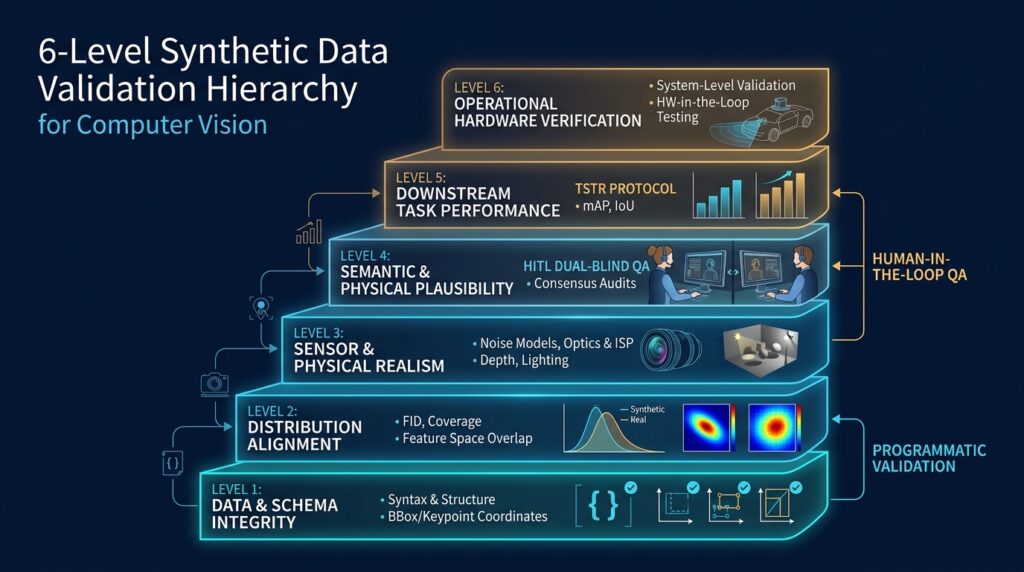
A practical synthetic-data audit can be organized into six validation levels, moving from basic data integrity to real-world model and hardware performance:
- Level 1: Data and Schema Integrity (Automated validation of label syntax, coordinate boundaries, parent-child class ontologies, and tracking ID consistency across frames).
- Level 2: Distribution Alignment (Statistical feature analysis via Fréchet Inception Distance, feature-space coverage metrics, and scenario-frequency balance).
- Level 3: Sensor and Physical Realism (Quantitative verification of noise profiles, optical distortion, ISP response curves, and temporal motion blur).
- Level 4: Semantic and Physical Plausibility (Human-in-the-loop review identifying physically impossible scenes, invalid object interactions, and guideline ambiguities).
- Level 5: Downstream Task Performance (Benchmarking via Train on Synthetic, Test on Real protocols to measure real-world mAP, IoU, and tracking accuracy).
- Level 6: Operational Hardware Verification (Evaluating edge latency, memory constraints, and runtime stability on the actual deployment hardware).
Distribution-Level Validation
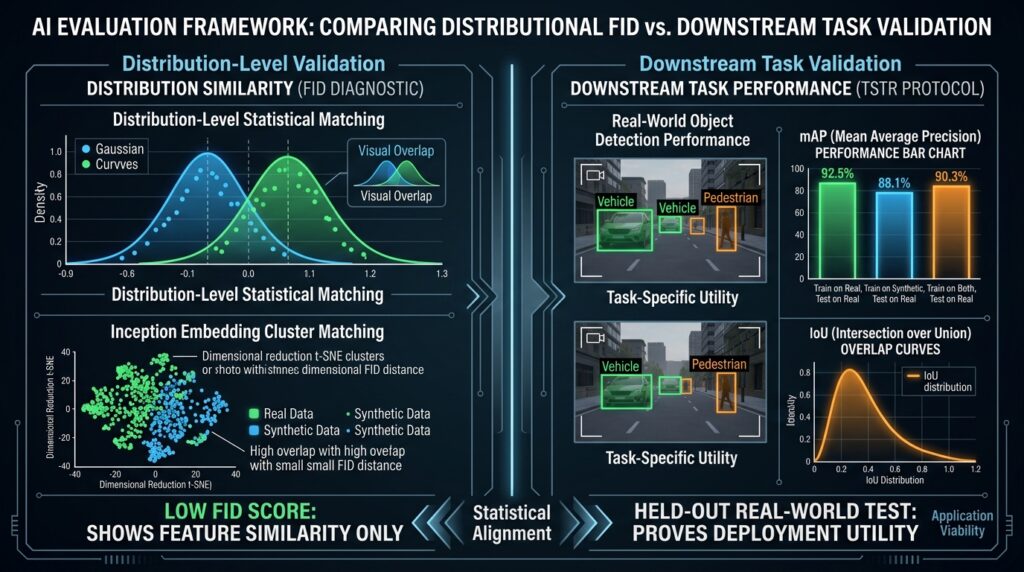
What does FID tell you?
FID measures the distance between feature distributions extracted from real and synthetic images. A lower score indicates greater similarity under the feature representation used to calculate the metric (typically a pre-trained Inception-v3 network).
What does FID not tell you?
It does not establish that a model trained on the synthetic dataset will perform well on downstream real-world tasks.
The FID formula in plain text:
FID(x,y) = ||mu_x – mu_y||^2 + Tr(Sigma_x + Sigma_y – 2(Sigma_x * Sigma_y)^(1/2))
In this equation, mu_x and mu_y represent the mean feature vectors of the real and synthetic distributions, while Sigma_x and Sigma_y represent their covariance matrices. The Tr denotes the trace operation.
FID provides a useful distribution-level comparison signal, but two datasets can have a low FID score while still exhibiting critical semantic differences that degrade task accuracy. Furthermore, FID relies on Gaussian distribution assumptions that may be inaccurate for complex multimodal datasets. Crucially, FID is dependent on the feature representation used to compute it; an ImageNet-trained feature extractor may not capture the characteristics that matter most in specialized domains such as medical imaging, industrial inspection, or spatial LiDAR perception.
Because of these limitations, robust evaluation frameworks supplement FID with additional distribution-level checks, including feature-space precision and recall metrics, classifier-based two-sample tests, coverage analysis, and scenario-frequency audits.
Sensor-Level Validation
Sensor-level validation asks whether the simulated sensor behaves sufficiently like the physical sensor for the characteristics that matter to the target task.
Typical checks include:
- Noise profiles
- Chromatic aberration
- Lens distortion
- Color response curves
- Temporal behavior
- Motion characteristics
Engineers can compare responses to standardized calibration targets (such as checkerboards or color charts) in both the physical sensor and simulated sensor pipeline. By measuring the Modulation Transfer Function (MTF) and the Signal-to-Noise Ratio (SNR) in both domains, teams can quantify specific aspects of the sensor gap.
Task-Level Validation and the TSTR Protocol
What is TSTR?
Train on Synthetic, Test on Real (TSTR) evaluates whether a model trained using synthetic data can perform effectively on an independently held-out real-world dataset.
To evaluate downstream utility rigorously, engineering teams implement structured experimental protocols comparing synthetic and empirical datasets across four configurations:
| Training Configuration | Test Dataset | Evaluation Protocol | What the Experiment Measures |
| Real Data Only | Real Holdout | TRTR (Train Real, Test Real) | Empirical performance baseline |
| Synthetic Data Only | Synthetic Holdout | TSTS (Train Synthetic, Test Synthetic) | In-domain simulation performance |
| Synthetic Data Only | Real Holdout | TSTR (Train Synthetic, Test Real) | Direct Sim2Real transfer capability |
The key comparison is not simply whether synthetic data produces good performance in simulation, but whether it improves or preserves performance on an independently held-out real-world dataset relative to a real-data baseline. Comparing the Mixed Training Protocol (Real + Synthetic) against the Real Only baseline provides a particularly important practical comparison: it demonstrates whether synthetic expansion actively enhances model robustness or merely adds redundant compute overhead.
Task-level evaluation measures specific downstream metrics across these experimental configurations, including mean Average Precision (mAP) for detection, mean Intersection over Union (mIoU) for segmentation, and Multiple Object Tracking Accuracy (MOTA) and IDF1 scores for tracking sequences.
Why Real-World Ground Truth Is the Validation Anchor
Why is real-world ground truth necessary?
Because synthetic data intended for physical deployment must ultimately be evaluated against representative physical-world observations. A carefully curated real-world reference set provides the empirical baseline against which synthetic-data utility and Sim2Real transfer can be measured.
Building Representative Reference Datasets
Building this reference dataset is a demanding engineering effort. The reference dataset must cover the operational distribution: lighting variations, weather conditions, specific sensor configurations, diverse object states, and rare edge cases. It must be sampled strategically to ensure that it represents the true operational design domain rather than just the most common scenarios. A carefully curated, diverse, accurately annotated real-world evaluation set can provide substantially more validation value than a much larger but redundant random sample.
Multimodal Ground Truth for Complex Vision Systems
Modern robotics and autonomous systems rely on multiple sensor modalities to perceive their environment. Validating synthetic datasets for these systems requires multimodal ground truth, including 3D LiDAR point clouds, radar cross-sections, and temporal video tracking data.
Different modalities require distinct ground-truth representations. In a camera image, a bounding box is defined by 2D pixel coordinates. In a LiDAR scan, objects are defined by 3D cuboids that capture spatial volume, heading, and velocity. Validating a synthetic sensor fusion dataset requires ensuring strict spatial and temporal consistency across these representations. If a synthetic camera frame depicts a pedestrian stepping into a crosswalk, the corresponding LiDAR measurements should be temporally and spatially consistent with the camera observation according to the simulated sensor timing and coordinate model. Establishing accurate real-world references for these complex scenarios is critical. For more information on handling spatial data, review our 3D point cloud annotation capabilities.
Human-in-the-Loop QA for Synthetic Data Validation
Automated metrics measure what has been explicitly programmed. Human review provides a vital validation layer by assessing whether a generated scene is semantically coherent and physically plausible.
Crucially, HITL review complements, rather than replaces, quantitative real-world model evaluation: human reviewers assess plausibility and semantic quality, while held-out real-world benchmarks measure actual transfer.
What Human Review Catches
A synthetic generation pipeline might render a vehicle. An automated bounding box verification script will confirm that the box accurately encloses the generated pixels. However, a human reviewer can quickly spot whether the vehicle is rendered without wheels, floating above the road surface, or intersecting with a nearby structure. Human review serves as a physical-plausibility and semantic-quality filter, catching anomalies when a simulator produces scenes that are computationally valid but physically impossible.
How to Structure HITL Review
Human-in-the-loop validation relies on structured workflows to ensure objectivity and precision. A useful methodology is independent dual review, where multiple annotators independently verify samples generated by the synthetic pipeline. By hiding the annotations of the first reviewer from the second reviewer, the workflow can reduce confirmation bias. Consensus audits are then used to measure inter-annotator agreement and identify visually ambiguous samples.
Programmatic QA Before Human Review
Before data reaches human reviewers, it must pass through programmatic schema validation. These automated checks verify label formatting, ontology compliance, spatial consistency, and temporal continuity. It ensures that bounding boxes do not exceed image dimensions, that parent-child class hierarchies are respected, and that object track IDs do not spontaneously change between sequential frames.
Measuring Reviewer Agreement
To quantify verification quality and ground-truth clarity, teams employ structured statistical metrics:
- Categorical agreement: Fleiss’ Kappa is used to evaluate how consistently multiple reviewers assign the same class label to an instance.
- Spatial agreement: Calibrated Intersection over Union (IoU) measurements and boundary metrics quantify agreement for bounding boxes and segmentation masks.
Handling Ambiguous Cases
The validation process will inevitably uncover scenarios that defy easy categorization, such as a vehicle heavily occluded by fog. Ambiguous cases are documented for ontology refinement, prompting the engineering team to clarify whether classes need adjustment. Teams looking to establish robust review pipelines can leverage specialized image annotation services to manage these workflows.
A Practical Synthetic Data Validation Workflow
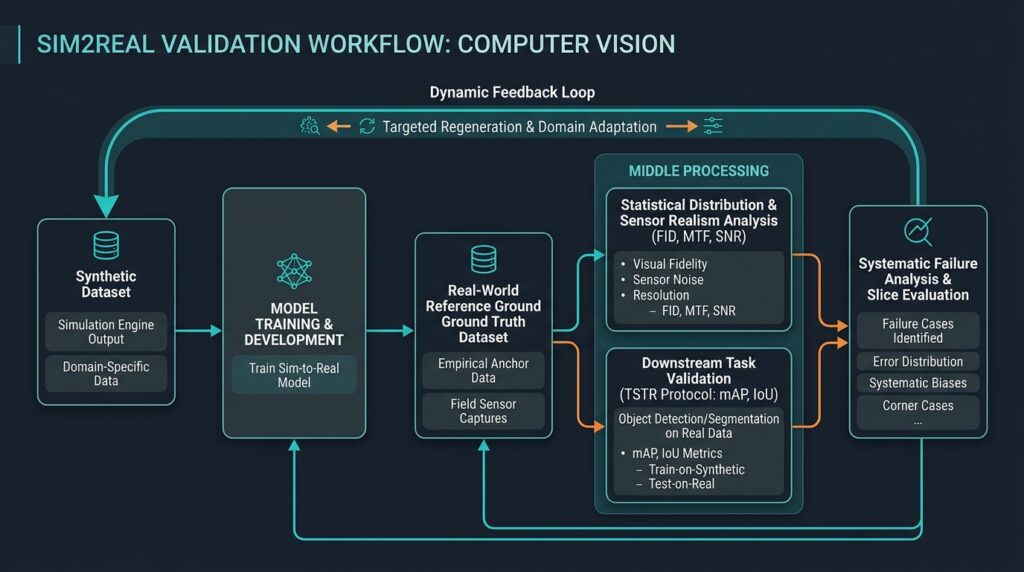
To execute validation systematically across production cycles, engineering teams should follow a structured nine-step operational workflow:
- Define the Operational Design Domain (ODD): Document environmental boundaries, lighting ranges, sensor setups, object classes, and target failure modes.
- Construct the Real-World Reference Set: Curate and annotate a high-variance empirical dataset to serve as the definitive evaluation benchmark.
- Audit Data and Schema Integrity: Programmatically verify syntax, bounding box coordinates, segmentation polygons, and class taxonomy formatting.
- Evaluate Distribution and Scenario Alignment: Compute FID, feature-space coverage, and class distribution frequencies against empirical reference baselines.
- Analyze Sensor-Level Discrepancies: Benchmark simulated sensor noise, optical distortion, and ISP transfer functions against physical camera profiles.
- Execute Physical and Semantic HITL QA: Deploy independent human verification to filter out physically impossible renders and resolve edge-case ambiguities.
- Train Baseline and TSTR Experimental Models: Train benchmark models across Real Only, Synthetic Only, and Mixed datasets to isolate transfer characteristics.
- Perform Systematic Failure Analysis: Conduct confusion-matrix audits and slice-based evaluations on real-world holdout data to identify residual domain gaps.
- Iterate Generation Parameters and Re-benchmark: Feed diagnostic failure modes back into the simulation pipeline, regenerate targeted data batches, and re-validate.
Closing the Loop: From Validation Back to Dataset Engineering
Validation is not the final gate in the synthetic-data pipeline. It is the feedback mechanism that tells the generation team what to change.
Validate → Diagnose → Modify → Regenerate → Retrain → Revalidate
For example, if a model consistently misses pedestrians at night on the real-world holdout set, failure analysis may reveal missing lens bloom, insufficient reflective clothing variation, or another gap in the synthetic scenario.
Each validation cycle produces actionable diagnostic information: which scenarios transfer well, which sensor characteristics are poorly modeled, and which edge cases remain underrepresented. Armed with these specific insights, the simulation team can adjust their environmental variables, alter their sensor profiles, and generate a new batch of highly targeted training data before retraining via our integrated model training workflows.
How LabelOps Supports Synthetic Data Validation
Synthetic-data validation depends on the quality of the real-world reference data used to measure transfer. LabelOps supports this layer through enterprise annotation and dataset-engineering workflows for complex computer vision applications.
Our capabilities include:
- Multimodal ground-truth creation: High-precision annotation for 3D LiDAR cuboids, sensor fusion alignment, and temporal video tracking.
- Hierarchical ontology design: Managing multi-tier class structures and resolving edge-case ambiguities.
- Structured HITL QA: Dedicated Computer Vision Engineers and QA Leads enforcing rigorous consensus and statistical agreement.
- Secure enterprise data workflows: Controlled environments incorporating role-based access control and data security protocols.
The objective is straightforward: provide the accurately annotated empirical reference data needed to determine whether synthetic data improves performance in the target domain.
Does Your Synthetic Data Transfer to the Real World?
Synthetic data becomes valuable when its contribution can be demonstrated against representative physical-world performance. A structured validation framework provides the evidence needed to identify gaps, refine the generation pipeline, and measure whether synthetic data improves the target computer vision system.
Explore LabelOps Dataset Engineering Capabilities
Frequently Asked Questions
- What is synthetic data validation?
Synthetic data validation is the systematic process of evaluating generated data to determine how effectively it transfers to real-world applications. It involves statistical distribution checks, sensor-level comparisons, and evaluating the performance of machine learning models on empirical reference data.
- What is the difference between synthetic data generation and synthetic data validation?
Synthetic data generation focuses on creating artificial data through 3D simulation, procedural rules, or neural rendering. Synthetic data validation focuses on measuring whether that generated data accurately reflects real-world sensor characteristics and improves downstream model performance on physical tasks.
- What is the Sim2Real domain gap?
The Sim2Real domain gap is the discrepancy in statistical distribution and visual appearance between a simulated environment and the physical world. This gap is caused by simulation artifacts, inaccurate sensor modeling, and differences in scenario coverage, which prevent models trained in simulation from performing well on real-world data.
- How do you measure synthetic data quality?
Synthetic data quality is measured through a combination of programmatic schema validation, statistical distribution metrics, and human-in-the-loop review. A particularly important practical measure is evaluating downstream model performance against a held-out, highly accurate real-world evaluation set using protocols such as TSTR.
- What is FID and why is it not enough for synthetic data validation?
Fréchet Inception Distance (FID) is a metric used to compare the statistical similarity of feature distributions between synthetic and real images. While it provides a useful diagnostic signal, it assumes a Gaussian distribution of features and cannot verify whether the synthetic data contains the correct semantic information necessary for downstream task performance.
- How does TSTR validate synthetic data?
Train on Synthetic, Test on Real (TSTR) trains a computer vision model exclusively on synthetic data and benchmarks its accuracy (mAP, IoU) on an independently held-out real-world dataset. Comparing TSTR results against a real-data baseline reveals how effectively the synthetic features transfer to reality.
- Why is real-world ground truth needed for synthetic data?
Real-world ground truth serves as the empirical anchor for evaluating synthetic datasets intended for deployment. Without a representative, accurately annotated collection of real-world data, teams have no baseline to prove that their synthetic data actually improves model performance in physical deployment environments.
- What is human-in-the-loop validation for synthetic data?
Human-in-the-loop validation involves expert reviewers analyzing synthetic samples and empirical reference data to identify semantic errors, physical implausibilities, and ontology mismatches that automated scripts cannot detect. This process includes edge-case review and inter-annotator agreement audits to ensure the dataset meets project standards.