


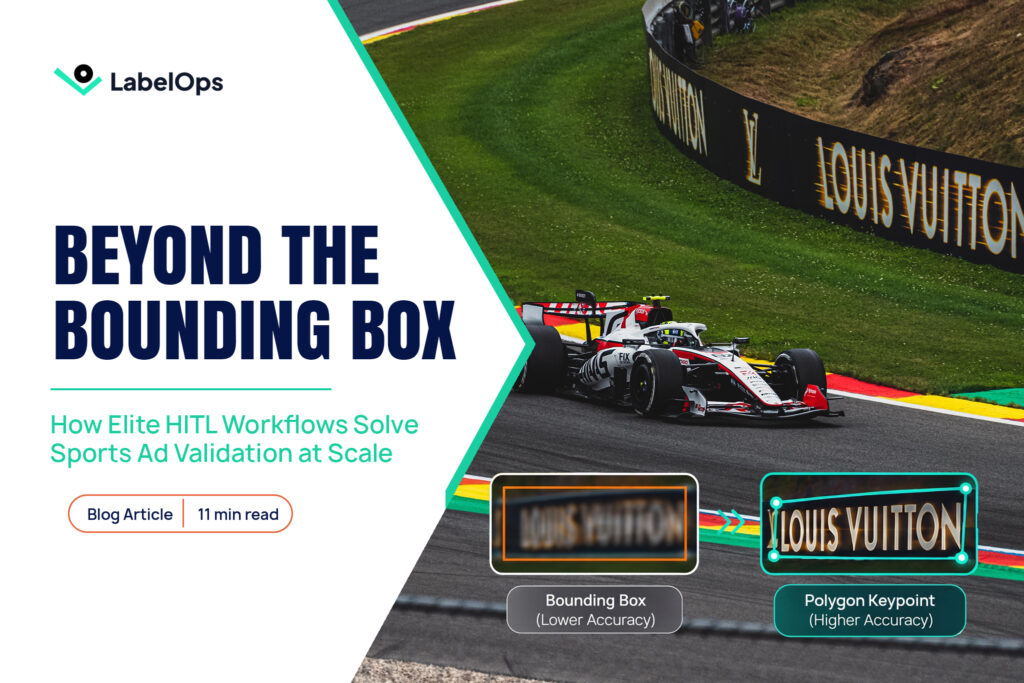
Just 70 minutes into the night match, the camera whips across the pitch. Smeared into the blur is the premium sponsor’s perimeter logo, and a referee steps in front of it; even the virtual overlay still needs to land on that board within the single frame.
By the next morning, the brand expects each of those moments to be counted correctly as proof. No doubt sports ad validation is the discipline delivering it; confirming that the jersey patch, logo, LED board, and virtual overlay appear where it needs to be, for as long as it needs, with the major clarity that sponsor paid for.
That is the most recurring challenge related to automated sponsor detection. Teams deploying computer vision (CV) models at scale rarely fail on compute or architecture. They hit a hidden wall of data decay, temporal misalignment, and labeling bottlenecks. When accuracy drops, client trust, proof-of-performance reports, and ad revenue drop with it.
At LabelOps, we rebuild annotation and quality-control infrastructure for sports media and ad-validation platforms. This post covers the technical problem, the Human-in-the-Loop (HITL) framework we implemented, and the measurable results.
Key Takeaways
◆ Your model is only as good as its labels. Sports ad validation accuracy is capped by annotation quality, not by backbone size or compute.
◆ Boxes break on live sports. Motion blur, occlusion, and lens distortion warp sponsor boards, so polygon segmentation and sub-pixel keypoints are needed to preserve true geometry.
◆ Occlusion needs explicit logic. Tracking objects through hidden frames and tagging partial versus total occlusion keeps exposure data defensible.
◆ Quality must be built into the pipeline. Gold-standard injection, inter-annotator consensus, and model-assisted pre-labeling sustain accuracy across 100,000+ frames per week and cut turnaround by over 45%.
◆ Measure the outcome. Partners moved from ~81.4% to 98.7% sponsor tracking precision, from 10–14 days to under 48 hours turnaround, and cut engineering QA time from ~35% to under 5%.
The Core Challenge: Why Sports Ad Validation Fails Under Velocity & Occlusion
Ad-validation models need pixel-level spatial precision and strict frame-by-frame temporal continuity. Standard object detection benchmarks rarely prepare a model for live sports, which adds four distinct failure modes.
High-Speed Motion Blur
Rapid camera movement turns high-value perimeter logos, jersey patches, and digital overlays into low-contrast smears. A detector trained on crisp stills sees a brand mark in frame 1 and a grey streak in frame 4. Without consistent labels for the blurred frames, the model never learns that both are the same sponsor.
Complex Occlusions
Referees, fast-moving players, rain, and lens flare continuously cut across ad placements. Each crossing creates a partial or total occlusion, and each one must be labeled differently if the downstream exposure metrics are going to mean anything.
Camera Angle And Lens Distortion
Wide-angle broadcast views change sponsor aspect ratios. A board that is a clean rectangle in the stadium becomes a skewed trapezoid on screen. Standard bounding-box models misclassify these shapes or miss the impression entirely, and those misses flow straight into sponsorship reports.
Dynamic Digital Replacement (DDR)
Overlaying digital ads onto physical stadium boards requires sub-pixel keypoint accuracy. Even a small drift in the corner coordinates produces visible glitches, such as floating graphics, edge bleed, or a virtual ad that slides against the board as the camera moves.
When teams rely on uncalibrated annotation workflows or generic off-the-shelf labelers, these edge cases snowball. Precision degrades, false negatives spike, and highly paid engineers burn sprint hours manually checking datasets instead of improving the core model.
Why Automation Alone Cannot Close the Gap
Now it can be tempting to treat these failures as a model problem and respond with a bigger backbone or more synthetic data. However, in practice, the ceiling is set by label quality. A model learns the boundary, the track identity, and the occlusion behaviour that its training data describes. If the labels blur the boundary of a sponsor board or reset a track every time a player walks past, the model inherits that ambiguity and reproduces it in production.
This is why the strongest sports vision teams pair automation with structured human judgment. Humans handle what is genuinely ambiguous: a logo half-hidden by a flag, a board reflected in a wet pitch, a virtual overlay that sits one frame behind the physical board. Automation handles volume. The engineering challenge is deciding where each one belongs in the pipeline.
The LabelOps Solution: A Three-Part Human-in-the-Loop Validation Framework for Sports
To move partners from error-prone ad-tracking runs to dependable automated validation, LabelOps implemented a targeted three-part framework. It is a practical example of human-in-the-loop validation for sports done as an engineered data pipeline, not an ad hoc review step.
Three principles shaped the design. First, every label must carry geometry that survives perspective change. Second, every object must carry identity that survives occlusion. Third, every delivery must carry a measurable quality score before it reaches a training run.
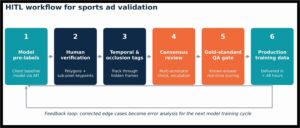
Figure 1: The LabelOps HITL workflow, from model pre-labels to production-grade training data
► Polygon Segmentation Annotation and Sub-Pixel Keypoint Ontologies
Rectangular bounding boxes fail when camera angles warp branding. A box drawn around a skewed board includes background pixels, crowd, grass, or neighbouring sponsors, and that contamination teaches the model the wrong boundary.
We replaced boxes with polygon segmentation annotations combined with sub-pixel keypoint mapping. Our sport-aware annotators track the exact corner points of physical and virtual ad boards as the camera angle changes. The result is tight spatial ground truth that follows the real geometry of each placement.
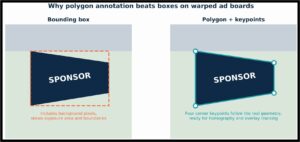
Figure 2: Bounding box versus polygon and keypoint annotation on a warped ad board
For engineering teams, this has three practical benefits:
• Cleaner Training Signal: Polygons exclude non-sponsor pixels, which improves segmentation and exposure-area calculations.
• Homography-Ready Labels: Corner keypoints give DDR and board-tracking models the coordinates they need to estimate perspective transforms.
• Consistent Ontologies: Every annotator follows the same rules for corner placement, edge handling, and board-to-board separation, so labels stay comparable across matches, venues, and broadcasters.
With this ontology in place, our teams delivered the spatial ground truth needed to sustain 99%+ overlay precision, even through swift camera pans.
► Frame-by-Frame Temporal Tracking and Occlusion Logic
Consider a player who cuts in front of an ad board for 5 frames of a 60 FPS sequence. Naive pipelines lose the object, reset the track, and may count one sponsor exposure as two, or none. Accurate ad placement validation depends on understanding that the board is still there even when it cannot be seen.
LabelOps built dedicated sports-video annotation teams trained on custom temporal occlusion guidelines:
• Continuous Tracking Through Hidden Frames: Objects are followed across occluded frames, so track identity survives the interruption.
• Structured Occlusion Metadata: Partial and total occlusions are tagged with explicit attributes, so downstream analytics can separate “visible but partly blocked” from “not visible at all.”
• Frame-Rate-Aware Interpolation: High-frame-rate interpolation keeps motion-blur tagging consistent across variable broadcast rates.
Guidelines matter as much as tooling here. Our annotators work from a written occlusion taxonomy with visual examples for each class, covering a referee crossing a board, a player’s arm clipping one corner, a camera operator’s shadow, and a full cut to a replay angle. Ambiguous cases are added back to the guideline, so the rules evolve with every new venue and broadcaster rather than staying frozen at project kickoff.
This level of sports broadcast annotation gives models something they rarely get: labels that describe what the scene actually contains, not just what is visible in a single frame. It also gives analytics platforms defensible exposure data, since each impression can be traced to a tagged, reviewed frame sequence.
► Video Annotation Quality Assurance: Gold Standards, Consensus and Model-Assisted Pre-Labeling
Quality at the scale of 100,000+ match frames per week cannot depend on spot checks. We built video annotation quality assurance directly into the operational flow, with three mechanisms working together:
• Gold-Standard Benchmarks: Test assets with known correct labels are continuously injected into annotator queues. Accuracy is measured in real time, and drift is caught before it reaches delivery.
• Inter-Annotator Consensus: Critical ad-boundary tags are reviewed by multiple annotators. Any discrepancy automatically escalates to an expert reviewer, which keeps ambiguous cases from silently becoming training noise.
• Model-Assisted Pre-Labeling (MAL): We integrate with client APIs to receive pre-labels from their baseline models. Our team shifts from pure manual drawing to rapid verification and edge-case correction, cutting turnaround times by more than 45%.
MAL also creates a useful feedback loop. The cases where annotators correct the model most often are exactly the cases the model finds hardest, so each delivery doubles as an error analysis for the next training cycle.
The Impact: Measurable Stability in Sports Ad Validation
By replacing fragmented, low-yield labeling setups with sports-specialized annotation infrastructure, our partners saw clear operational results.
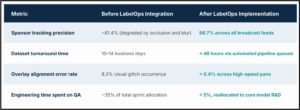
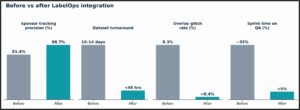
Figure 3: Before and after LabelOps integration
For leadership teams, the last row matters most. When roughly 35% of sprint capacity goes to checking datasets, the cost is not only labor. It is delayed features, slower model iteration, and a longer path to the next client contract. Dropping that figure below 5% turns annotation from a recurring drag into a predictable input.
The numbers point to a pattern worth noticing. Precision and overlay quality improved because the labels improved. Turnaround fell because verification replaced drawing. And engineering capacity returned to the roadmap because QA moved out of the sprint and into the data pipeline.
A Practical Checklist: Evaluating an Annotation Partner for Sports Ad Validation
Whether you build in-house or work with a specialist, these are the questions that separate a production-grade data engine from a generic labeling queue:
1. Does The Ontology Match Your Geometry?
Ask whether the partner supports polygons, keypoints, and per-frame attributes natively, or only boxes.
2. How Are Occlusions Defined And Audited?
Look for a written taxonomy, structured metadata, and reviewer sign-off, not free-text notes.
3. Is Quality Measured Continuously?
Gold-standard injection and consensus scoring should run on live queues, not as an end-of-project audit.
4. Can The Workflow Plug Into Your Stack?
API-based pre-label ingestion and automated queue routing determine whether turnaround is days or hours.
5. Do Annotators Understand The Sport?
Knowing how a camera cuts between a main feed, a tactical view, and a replay prevents a whole class of labeling errors before they start.
6. Does The Partner Report Error Rates By Scenario?
Aggregate accuracy hides weak spots. You want precision broken out by blur level, occlusion type, and camera angle.
If your current pipeline struggles on more than two of these, the bottleneck is probably upstream of your model. That is good news, because data-side problems are usually faster and cheaper to fix than architecture-side ones, and the gains show up in your next training cycle.
What This Means for Your Team
The same framework applies across the teams building and buying sports ad validation capability. The common thread is that annotation stops being a back-office task and becomes a measurable part of the product:
• CTOs & Heads of AI: Treat annotation as production infrastructure with SLAs, quality gates, and measurable error rates. Reclaiming 30 points of sprint capacity is a roadmap decision, not just a cost saving.
• Computer Vision Engineers: Move beyond boxes. Polygon masks, corner keypoints, and explicit occlusion attributes give your models the geometry and temporal context that sponsor detection requires.
• Sports Analytics & Sponsorship Measurement Platforms: Structured metadata and consensus-reviewed labels make exposure reports auditable, which is what clients and rights holders ask for when numbers are disputed.
• AI Operations & Data Operations Leaders: Gold-standard injection and escalation rules replace manual sampling, so quality scales with volume instead of against it.
• Teams Building Brand Exposure Analytics & Virtual Advertising: Sub-pixel keypoint consistency is the difference between a seamless overlay and a visible glitch on a live feed.
Building the Future of Sports Media with LabelOps
Sports ad validation leaves no room for visual distortion, missed impressions, or delayed reporting. Whether you are scaling brand-exposure analytics, powering dynamic virtual LED replacement, or building the next generation of CV tools for live sports, your model is only as good as the annotations beneath it.
LabelOps provides the domain expertise, scalable infrastructure, and dedicated human-in-the-loop workforces required to turn noisy match footage into production-grade training data.
Ready to Stabilize Your Sports Vision Pipeline?
Partner with LabelOps to scale your dataset capabilities, resolve edge-case errors, and deliver dependable performance to your clients.
Book a Technical Consultation with the LabelOps Team